Weimar Germany
-
Emergence of authoritarian states: Conditions in which authoritarian states emerged; economic factors, social divisions, impact of war, weakness of the political system
-
Weimar Germany: Constitutional, political, economic/financial and social issues (1918-1933); initial challenges (1918-1923); “Golden Era” under Gustav Stresemann (1924-1929); the crisis years and the rise of Hitler (1929-1933)
German foreign policy (1919-1933): aims, issues, and extent of success
Jump to sections
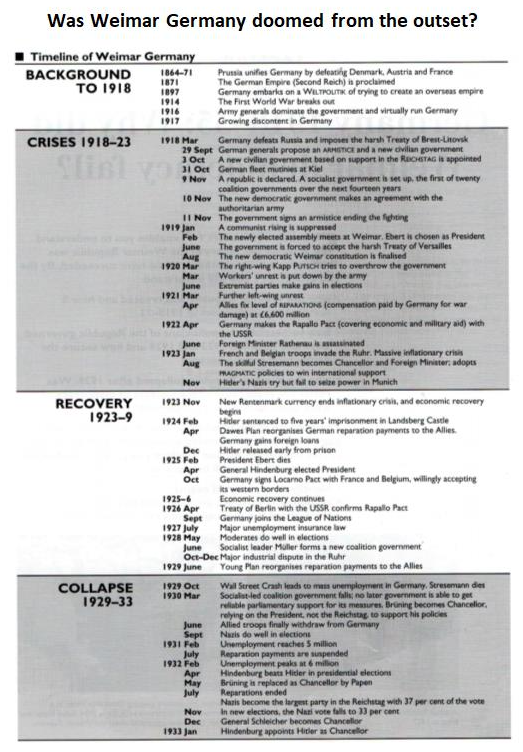
What was Weimar Germany?
Weimar Germany was the period of a democratic government between 1918 and 1933
Constituent assembly hosted in Weimar, a city in Central Germany - Mainly due to the violence in Berlin
Created by the civilian takeover of the government before the end of World War One
Republican government was the one to sign the Treaty of Versailles, making it a controversial government from the outset
The government worked as such: There was a Reichstag which was the parliament, a president, and a chancellor. The chancellor was the leader of the Reichstag, and the president was the leader of the country elected every 7 years. The president could appoint the chancellor but the Reichstag limited the president’s power. However, the president could order a state of national emergency and rule by decree under the Republic’s constitution Article 48. The country was divided into 18 states under a federal system where each state had its own government.
The Reichstag had a total of 647 seats by the time of its dissolution
Many of the civil servants remained the same from the Kaiser’s rule
Republic proclaimed on 9 November, 1918
The Republic faced numerous economic, social, and political issues from its beginning, the study of Weimar Germany will include understanding these issues and why they led to the emergence of Nazi Germany
Conditions in Weimar Germany
Economic Factors
Hyperinflation - 1923
French and Belgians occupied the Ruhr due to German nonpayment of reparations (A clause in the Treaty of Versailles deemed this legal), this was the main industrial area of Germany
The government simply printed more money to support passive resistance to the French in the Ruhr, which made the money increasingly worthless
The hyperinflation made the savings and income of the middle class worthless, which pushed them to more extreme antigovernmental ideologies
Economy was stabilized in 1924 with the introduction of the new Reichsmark, a success of Gustav Stresemann
The Ruhr area provided over 80% of Germany’s coal production and 80% of the steel production, which meant losing this put Germany’s economy into a collapse
People could exploit the hyperinflation to get rich
By November 1923, $1 USD was worth 4.2 trillion German Marks
Borrowing from the United States
Borrowed money from the United States to pay reparations to Britain and France
This meant that when Wall Street crashed in 1929, Germany was hit hard
Dawes Plan of 1924 reduced the total reparations amount and gave American loans to Germany
The 1928 Young Plan aimed to finally set the total reparations payments at $29 billion to be paid over 58 years and give Germany another loan, but this loan never ended up happening because of the Wall Street Crash which caused the United States to withdraw all financial support
Many workers still depended on agriculture
During the war, the government had taken out many internal debts as they were confident they would win the war and pay the debts back with the money they’d take
Social Division
State of Germany at the end of the war:
Mass suffering, hunger, disease - Tuberculosis & the Spanish Flu
Suffering lead to the emergence of radical Socialists & Nationalists and government takeover attempts
Many social revolutions
Extremism
Many blamed the government for the economic and social problems, many still retained nationalism and wanted to make Germany better and fix the issues
Many of the political and economic issues can also be considered social issues, as they directly caused the social situation in Germany
Impact of War
2 million military deaths, 5.7 million wounded
Lost 10% of its land - Alcase-Lorraine, West Prussia, Posen, Silesia, Eupen, Malmedy, Moresnet, Northern Schleswig, Hultschin, Danzig
Upper Silesia was a very industrialized region, made the economic difficulties worse
Saarland - A coal mining region on the border with France - would have all its economic output sent to France as reparations, causing loss of economic output
6,600 million British Pounds to be paid as reparations
Germany declared in 1922 that it would be unable to make the payments
Allied blockade on trade remained in place until Germany signed the Treaty of Versailles in mid-1919
600,000 war widows, almost 2 million children without father
Internal debt of 469 billion marks
Real national income was 2/3 of what it had been in 1913
Food became very expensive during the war, which created poverty but also worsened the divide between the wealthy and poor as now only certain people could afford food
Women who had worked in factories were now reluctant to return to traditional roles
Additionally, soldiers demanded their jobs back
The losses of war and the political and economic implications of that meant that upon the Republic’s creation, many people were already moving towards radical ideologies
The mass strikes towards the end of the war gave people the idea that they could fight for what they wanted, meaning many people joined strikes and coups
Workers strikes also strengthened the left-wing parties
Upon the creation of the Republic, its first job was to sue for peace. This meant much of the population blamed the Republic for the end of the war rather than the military high command, who actually remained fairly influential in the interwar era
The German people were expecting much more lenient terms in the Treaty of Versailles, and were shocked when they lost substantial territory and saw the restrictions placed upon them
Food was scarce during the war due to the need to feed soldiers. Once the war ended, food was overproduced, and the price of produce fell, which small-scale farmers in Germany being hit particularly hard
Later in the 1920s, they were getting little capital from their labor while also being heavily taxed with high interest rates
Political Problems
The Republic was called the Weimar Republic because the constituent assembly was hosted in the town of Weimar due to so much violence in Berlin, though Berlin remained the capital
Constitutional weaknesses
Article 17 decreed the proportional representation system that the Weimar government struggled with throughout the 20s
Article 48 gave the president the ability to declare a state of emergency and rule by decree
The remaining army was very hostile to the Republic
Multiple Communist-inspired revolts
Spartakist Uprising in Berlin in January and March 1919
Put down with extreme brutality - leaders murdered and uprising suppressed
Munich until May 1919
Ruhr Valley in March 1920
These came from the treatment of workers during the war and them seeing the success of the Communist revolution in 1917
Ultra-Nationalist attempted coups
Kapp Putsch in Berlin in 1920 by a paramilitary organization
Led by former bureaucrat Dr Wolfgang Kapp, who was imprisoned and exiled following the coup
Kapp’s right-wing organization aimed to install a Prussian government, so they marched on Berlin and Kapp as chancellor
Munich Putsch attempt by Adolf Hitler and the Nazi Party in 1923 - Led to Hitler’s imprisonment
Nazi party members who died were seen as Martyrs and Hitler got national recognition from the radio coverage, which gained him much support
Hitler was released 9 months later
Ludendorff was also involved
Hitler lived in comfortable conditions, frequently got gifts from the outside world, and had the time to write Mein Kampf
Freikorps - Right wing mercenaries paid by the government who fought with the army to prevent and quell uprisings, eventually switched sides
Formed under the Monarchist regime and continued to suppress attempted revolutions under the Republic
In reality, they despised the Republic, and later helped the Nazis gain power
All other factors combined led to people looking towards more extreme sides of the political spectrum such as Communism and Nazism
German soldiers were angered at the armistice in 1918
They didn’t feel defeated, as they were still on Belgium and French land and had beaten Russia in the east
After all their work, the government just gave up
“Stab in the back” theory - The dead soldiers had been betrayed by the government led by ‘Marxists and Jews starting to start a revolution’
Many of the leaders of the opposition (the Communists) were Jewish, making them ‘convenient scapegoats’
Article 48 of the constitution was used many times by President Ebert between 1919 and 1923 - ‘Democratic’ Republic had a built-in authoritarian element
President Ebert declared that he ‘hated the revolution like a sin’ and he did not want to see ‘Russian conditions’ in Germany - Political polarization
Civil servants were from the Kaiser era - Very sympathetic to right-wing Nationalist movements while very against left-wing Communist movements
Judges would give harsh sentences to those accused of left-wing conspiracy while giving lenient sentences to right-wing convicts such as Hitler
Multiple political assassinations took place
To discredit the government and hope for a extremist takeover
Both sides, left and right, did them
Foreign Minister Walter Rathenau was assassinated in 1922, he supported the Treaty of Versailles
Mathias Erzberger was assassinated, he signed the armistice and called for peace
All important groups were hostile to the Republic when it was created - German People’s Party and the right-wing German National People’s Party
Both parties eventually supported the Republic
German People’s Party was led by Gustav Stresemann
Nationalists supported the Republic for strategic reasons
Eventually lead to somewhat broad support for the republic
Ludendorff, a significant political figure especially to Nationalists, was very anti-Republic, as he wanted the government to take all the blame for the end of the war
Separatism in Bavaria
Hindenburg is elected as president in 1925, very nationalist figure and seen as a remnant of the old Imperial era of Germany, showed the people’s desire for a strong Germany
Political parties could not agree - Made the decision making process long and arduous
Proportional representation government system - A party would get the amount of seats in parliament equal to their share of the vote (e.g a party with 20% of the vote would get 20% of the seats)
Though this system was fair, it resulted in a slow decision making process, as the ideological divide between parties meant that not much could get done because of so many disagreements
Between 1919 and 1928, there were a total of 15 different cabinets, with none lasting more than 18 months and some lasting for only 3
Political Parties in Weimar Germany
SPD
Supported a moderate socialist Republic and parliamentary democracy
Working class support
Supported the Republic
USPD
German Independent Social Democratic Party
Formed in 1917 as a breakaway from the SPD
Aimed to create a socialist republic governed by workers and soldiers councils alongside a national Reichstag
Working class support
22 seats in the Reichstag in 1919, 83 in 1920
Somewhat supported the Republic
KPD
Aimed to enact a soviet-style revolution and create a soviet republic based on the rule of workers and soldiers’ councils
Working class support
0 seats in 1919, 4 in 1920
Did not support the Republic
ZP Zentrumspartei
Center party
Aimed to defend interests of the Roman Catholic Church
Supported the Republic (Though they became more right-wing sympathetic from the late 1920s)
Wide range of support from landowners to trade unionists
91 seats in 1919, 64 in 1920
DDP Deutsche Demokratische Partei
German Democratic Party
Left-leaning liberal party which was committed to a democratic constitution
Professional middle classes support
75 seats in 1919, 39 in 1920
Supported the Republic
DNVP Deutschenationale Volkspartei
German National People’s Party
Based on old conservative party - Monarchist and anti-Republican
Monarchist and anti-republican support
44 seats in 1919, 71 in 1920
Did not support the Republic
DVP Deutsche Volkspartei
German National People’s Party
Right-leaning liberal party; although voted against the new constitution, it became a supporter of parliamentary democracy under Stresemann
Middle classes and business interests
19 seats in 1919, 65 in 1920
“Golden Era” under Stresemann
Stresemann was the foreign minister between 1923-1929
Improved relations with France and Britain
Germany joined the League of Nations in 1926
He was somewhat unpopular among the Germans, but very popular internationally - “The good German”
Died in October 1929, same month the Great Depression began
Allied troops left the Rhineland in 1929
Helped introduce the Reichsmark, which put an end to the hyperinflation crisis
He recalled all old marks and burned them
Negotiated the Locarno Treaties with Britain and France (among others)
Germany accepted the western borders
1925
Germany joined European diplomatic relations
The Allies would withdraw troops from the Ruhr
Allies would commit to the evacuation of the Rhineland in 1930, 5 years ahead of schedule. The Rhineland was under the control of the Allies
Stresemann refused to sign a similar treaty with Poland, “There will be no Locarno of the east”
Unpopular among the right-wing nationalists
Afterwards, the French withdrew their objection to German entry into the League of Nations
Promoted reconciliation and cooperation with France and Britain
Negotiated the Dawes plan in 1924 - Brought economic stability, foreign loans, and re-evaluated the reparations payments
Reduction in reparations from 123 billion gold marks to 121 billion to be paid over 58 years
$500 million loan from foreign banks
Ended passive resistance to French occupation of the Ruhr, along with ending the state of emergency Ebert had instated to use emergency powers
Successfully defended the Republic against physical threats by extremist organizations until 1929
Exports doubled between 1924 and 1929
Believed rebuilding relations with France and Britain was the only way to gain ‘breathing space’ to rebuild the economy
Effectively crushed attempted Communist uprisings in Saxony and Thuringia
"The most important objective of German politics is the liberation of German territory from French and Belgian occupation. First, we must remove the strangler from our throat" - Stresemann, in a letter to Wilhelm II
Successfully solved the hyperinflation issue
Reaffirmed the Rapallo Treaty of 1922, strengthened ties with Soviet Russia
Co-winner of the 1926 Nobel Peace Prize for his work on Locarno
Signed the Kellogg-Briand Pact in 1928, which renounced the use of violence to solve conflict. This led the way to the 1929 Young Plan, which was meant to bring more foreign investment.
Strengthened economic ties with the United States
USA and Germany were strong trade partners
Germany got valuable resources from the USA
USA got manufactured goods from Germany
German economic recovery was thus an interest of the USA
Possible failures
Many believed Germany should completely reject the Treaty of Versailles
Rejection of the borders
Maintain a strong military to avenge the Treaty of Versailles
Very dependent on the US economy
Some missed the monarchy and worried of a loss of traditional German values - somewhat unpopular among Germans
Only the working class saw the economic benefits, the middle class had all their savings lost without any compensation
Stresemann aimed to regain the lands from Poland, which led to him being hostile towards the east and allowing Polish economic crisis to continue. This hostility led to France never fully trusting Germany, making them less likely to remove the foreign restraints
The farmers income issue described in the ‘Effects of war’ section
Small shopkeepers were being overshadowed by the introduction of big department stores, putting traditional shops out of business and causing the loss of jobs, these shopkeepers blamed the Republic and moved more towards extremism
Despite the attempts to move towards a friendlier Republic with modern ideals, the general public elected Hindenburg after the death of Ebert in 1925, showing they still had nostalgia for the old German Empire
Hindenburg made frequent use of Article 48, effectively ending the accountable government through replacement
Though there was economic upturn, industrial production was still behind other European states, but that was improving
Germany had fallen from their top production spot since the First World War
Unemployment hovered around 1 million even before 1929
The government had leaders that commanded respect
He was acceptable by more conservative parties, though he did not support the right-wing radicals, as his background was that of an orthodox conservatives
End of the Weimar Republic
Death of Stresemann - October 1929
Loss of stabilizing political influence and potential improved relations with the rest of the world
Great Depression - 1929
Increased radicalization
All foreign investment immediately withdrawn, caused another economic crisis
Destabilized the economy
Economic success may have gained the Republic more popular support
The sudden withdrawal of foreign investment meant some factories had to close or reduce their workforce, resulting in high unemployment
6 million unemployed by 1932, but the estimates including seasonal workers, casual laborers, and unregistered women would reach closer to 9 million - Between 9% and 13% of the population
This was actually better than the United States, which was at 23.6% in 1932, though the USA was not hit as hard industrially because they weren’t as reliant on foreign investment
6 million was 1/3 of the worker population
By 1932, the national income was 39% less than it was in 1929
Chancellor Bruning was appointed by Hindenburg in March 1930, he refused to stimulate demand or reflate the economy though he did protect farmers
Last democratic government replaced by a government that did not have a parliamentary majority in March 1930
Led by Heinrich Bruning
Later publications of his memoirs showed he intended to establish an authoritarian government, possibly even restore the monarchy
It has been shown he intentionally made the economic crisis worse for his own political gains
Government fell in 1931
Bruning’s government was then replaced by von Papen’s, then von Schleicher only a few months later
Hindenburg used his emergency powers as President to dissolve the Reichstag to replace it with this one in 1930
Death of the government
Hindenburg lost control of the political situation after 1930
Bruning lost Hindenburg’s trust in 1932
Reichstag increasingly broke down
Bruning banned the SA in 1932
Reichstag met less often as the months went by
In session for 94 days in 1930, 42 days in 1931, and 13 days in 1932
During this time, there were 98 Reichstag laws passed in 1930, 34 in 1931, and 5 in 1932
Additionally, 5 presidential decree laws passed in 1930, 44 in 1931, and 66 in 1932
Bruning’s government did not resolve the economic crisis, all it did was to cut spending, reduce welfare payments, and increase funding for the unemployment scheme
von Papen and von Shliecher lost almost all support
Hindenburg was reluctant to bring the army into politics through a coup or integration
As long as the Reichstag existed, it would oppose any attempt to establish an autocratic government, but abolishing the Reichstag may trigger a civil war
Success of the Nazis
First major success in 1930
Slowly gained power afterwards
Though they never actually gained a majority, Hitler was appointed to Chancellor by President Hindenburg due to his popular support
In September 1930, Bruning called for a general election though there was no need for it. His intent was to gain more seats in the Reichstag, but instead the Nazis gained significant ground
Nazis had 12 seats after the 1928 election, but had 107 after the 1930 election
The Nazis knew the importance of elections in gaining power, as Hitler’s failed coup in 1923 showed them they couldn’t take the government by force, they had to win more than 50% of seats to take over the government
Quickly growing support for the Communists and Nazis after 1930
July 1932 Elections showed a massive increase in support for both parties
July 1932 Election results: Communists won 14.5% of the vote and the Nazis won 37.4% of the vote
As the democratic parties could no longer hold a majority even with a coalition, there was nothing they could do
Hitler tried to become Chancellor in 1932, but Hindenburg refused
von Papen called another general election in November 1932, and the Nazi share went down to 33.1%, and Hitler appeared to have failed. Fritz von Papen was no longer Chancellor after November 1932, replaced by von Schliecher, who resigned in 1933
Schliecher believed that bringing the Nazis into the government would actually tame them, as they would become less extreme once they actually had power
von Papen and his associated believed giving Hitler the Chancellorship would make him easy to manipulate, so they could gain political power, but they had to convince Hindenburg
After Schliecher resigned, von Papen and Hindenburg’s son Oskar pressured Hindenburg into offering Hitler the chancellor spot
Hitler ran against Hindenburg for presidency in 1932. Hindenburg won, but Hitler got almost 37% of the votes, making him a valid choice for political leader
Regional Nazi support in the 1932 Reichstag elections reached 40% in some places, though the overall support fell
The Nazis exploited the fragmentation of the Reichstag to gain more support
By being vague with their promises, the Nazis were able to gain support from people who were desperate for some form of change to save them from poverty
Pledges to work for the people, combat Communism, combat Jews, and fix the economic crisis while also making Germany a power like it used to be
Hitler was surprisingly not corrupt, and his status of being a war veteran added to his credibility
Hitler was a great public speaker, meaning he could sway the ideals of the masses - More about Hitler’s role in the Nazi Germany page
Nazi tactics to gain power will be on the Nazi Germany page
Strengths of the Weimar Republic
Politics
Hindenburg was elected president, seen as a respected political figure due to his service to Germany during the war
Largely an expression of nostalgia for the strength and stability of the previous Germany
“The truth is… that Germany wants no president in a top hat. He must wear a uniform and plenty of decorations”
Hindenburg defended Republican democracy even in the face of right-wing threats
The Allies from the war desired to prevent the Republic’s collapse and foster recovery, foreign cooperation was vital to the Republic’s survival
Financial stability came with more political stability
Economic recovery slowed the progress of Nationalist opposition by appeasing industrialists
Reichstag elections in May 1928 showed the slow of the growth rate of extremist opposition
An attempt to oppose the Young Plan by the Nationalists and Nazis failed
Financial
Rescue of the German currency and regulation of reparations
Stresemann’s currency reforms saved the German economy
To the international stage, the German economy represented a picture of stability and prosperity
Establishment of industrial combines that increased industrial capacity in 1926
Industrial production figures in 1927 matched those of 1913
Foreign Affairs
The most successful aspect of the republic
Policy of fulfilment was carried out during this time and was both sensible and realistic. Designed to encourage future allied leniency towards Germany
Stresemann was most successful as foreign minister
He combined the broad principles of fulfilment with an attempt to lay foundations for the revision of the peace treaties
He was eager to put cooperation in the place of confrontation
His main aim was to rid Germany of foreign restraints and to regain full sovereignty
The Dawes plan in 1924 and the Young plan in 1929 are classic examples of fulfilment as they reduced Germany’s total reparations debt and gained foreign recognition of its difficulties in paying off it all
This cooperation allowed Germany to join the League of Nations in 1926
From January 1926, Germany began to see the benefits of this policy
In Jan 1926 the British withdrew from Cologne, which marked the first major reduction of the occupying forces
In Jan 1927, the Inter-Allied Control Commission, the major “watchdog” of the Treaty of Versailles, left
The evacuation of foreign troops was completed by the French withdrawal in August 1929
Bruning successfully applied to the US for a legal delay in reparations payments
The tragedy was that the government failed constantly to convince the political extremists of the constructive good sense of this policy
When the international economic crisis undermined the republic, its foreign policy of restrained national reassertion would become one of the first casualties of the collapse
Was the Republic secure at the end of the 1920s?
Despite the improvements the Republic still had many weaknesses
It seemed to be winning the public relations battle as the end of the 1920s approached, but it had established few durable institutions to sustain it in times of crisis
Nor had the Republic developed a system of parliamentary parties strong enough to give stability to its democracy
The classic coalition parties (Social democrats, the Democratic Party, and the Center Party) remained divided on many points of economic, political, and religious doctrine
The lack of cohesion in the face of popular anti-democratic movements would play a major role in the disasters of the early 1930s
Very importantly, for all the appearance of prosperity, the basis of the German economy was unsound, which is why it collapsed so quickly in 1929
Industrial investments and government expenses were not adequately financed from German capital or German profits
More than a third of all capital investment in Germany in the late 1920s came from foreign loans. Imports between 1924 and 1930 were always greater than exports
The total deficit of the German budget over these years amounted to nearly 1.3 billion Reichsmarks
It is impossible to deny that between 1924 and 1929 the Weimar Republic was progressing and was achieving some signs of permanency
In the limited period, however, normality was never quite reached, and when it appeared close it proved to be only a brief interlude between two disasters
What allowed the Weimar government to survive?
Military support
On November 10 1918, President Ebert created a pact with Wilhelm Groener, who was Chief of Staff of the German military. In this pact, Groener pledged military support against the enemies of the Republic in exchange for allowing the army some autonomy
This helped put down left-wing revolts such as the Spartakist uprising
They did not help crush right-wing revolts such as the Kapp Putsch
The army and Freikorps enjoyed crushing Communist revolts
Article 48 of the constitution allowed the president to enact emergency decrees to defend the democratic republic
The civil sector was very hard on communist uprisings
This helped prevent the establishment of Soviet-esque socialist republics
Gustav Stresemann stabilized the economy and political situation
Appealing to the workers
The Socialist governments appealed to the workers, which was used when the army refused to crush the Kapp Putsch. The government appealed to the workers and they started a strike, which effectively halted all activity in Berlin and caused the Putsch to fail
Historiography
By 1929, no man in the Weimar Republic other than Stresemann did more to destroy the Treaty of Versailles
Detlev Peukert - German historian
Stresemann’s aim of finding international agreement, specifically with France, failed due to his inability to settle an ‘Eastern Locarno’. This meant that French was still mistrustful of Germany.
J B Duroselle - French historian
“The Republic was brought from abroad by a wise man; He didn't say what should be done with it: it was a republic without operating instructions."
Alfred Döblin - German novelist
“Born in defeat, humiliated by Versailles, mocked and violated by its irreconcilable enemies at home, the Weimar Republic never gained the popular acceptance which alone could have given its parliamentary system permanence, even in crisis.”
Fritz Stern - German-American historian
“… which meant in practice that as few changes as possible were made to the Wilhelmine social structure… In these circumstances it is not surprising that there very soon arose deep disappointment with democracy among the popular masses”
“A republic without republicans, a democracy without democrats”
György Lukács - Hungarian Marxist writer
Germany ‘squandered freedom’. The middle classes who abandoned their traditional liberal attitudes are to blame for the death of the Weimar Republic. Also blames the “extreme autism” of the German public (By which he likely means the lack of engagement)
Hans Mommsen - German historian
The political parties failed to fulfill their democratic responsibility
Ernst Fraenkel - German-Jewish politician
The doubling of wages between 1924 and 1929 and the higher standard of living from before the First World War is clear evidence of Stresemann’s economic success
Peter Pulzer - Austrian historian
The extremism in German came from the national disgrace that came from the humiliating terms of the treaty of Versailles imposed on Germany by the Allies
Ian Kershaw - British historian
The DNVP’s status as a far-right party rather than a mainstream conservative party was a main reason for the Weimar Republic’s downfall
William L Shirer - American historian
Hitler didn’t seize power, he was given power by the weakness of the Weimar Republic, its systems, and its politicians. Hitler didn’t force himself in, he was invited in by those inside.
AJP Taylor - British Historian
The rise of the Nazis was due to the destruction of German tradition post-World War and the economic issues of the 1920s, which destroyed the financial independence of the middle class.
The effects of World War One are the main reason the Nazis gained power and the main reason that the Weimar Republic failed. The ideological shifts from the end of the war to more materialistic views meant the most success was found by pleasing the masses.
Gerhard Ritter - German historian and solder in WW1
“As long as the fate of the Republic remains the emotional center of Weimar history, the widespread political mobilization of working- and middle-class Germans and the political dynamic that culminated in the Nazi victories of 1932 will remain misunderstood. At issue in the 1920s was not simply the recovery of social stability or economic prosperity but questions of cultural value, political entitlement, and nationalist sentiment.”
Peter Fritzsche - American historian
Hitler was one of the first to be able to avail himself in the means of modern technology
Albert Speer - German minister under the Nazis
Stability in Germany after 1924 was actually a façade and underneath, there were many cracks in both the political and economic sense
Mary Fulbrook - British historian
There was a clear link from the economic decline to the people turning to extremist ideals
Harold James
The DNVP is at fault for the fall of the Republic, due to their failure to reconcile with it
“Under the cloak of loyalty to the Monarchy, they either held aloof or sabotaged the efforts of successive Chancellors to give a stable government to the Republic. The truth is that after 1918 many German Nationalists were more influenced by feelings of disloyalty to the Republic than of loyalty to the Kaiser, and it was this motive which led them to make their fatal contribution to bringing Hitler to power.”
John Wheeler-Bennett - Conservative British historian
The social factor leading to Weimar’s death was the most important, more than political and economic factors. The elite groups were the problem, such as the businessmen and estate owners, as they were the ones spreading nationalism, anti-semitism, and anti-democratic sentiments.
Hans Ulrich-Wehler - German historian
Weimar Republic was unwanted and unloved from its origin
Timothy Snyder - American historian
Germany never conquered democracy for herself
Theodore Heuss - Politician and president of West Germany from 1949-59
The SPD failed to make their early association with the bourgeois parties a lasting and constructive partnership
John Hiden - British Historian