Chinese Civil War
-
Causes: Economic, ideological, political, social, etc; short and long term causes
Practices: Tactics and impact on outcome
Foreign influence: Foreign involvement and impact on outcome
Effects: Political, social, economic, demographic; short and long term; changes in the role and status of women
Jump to sections
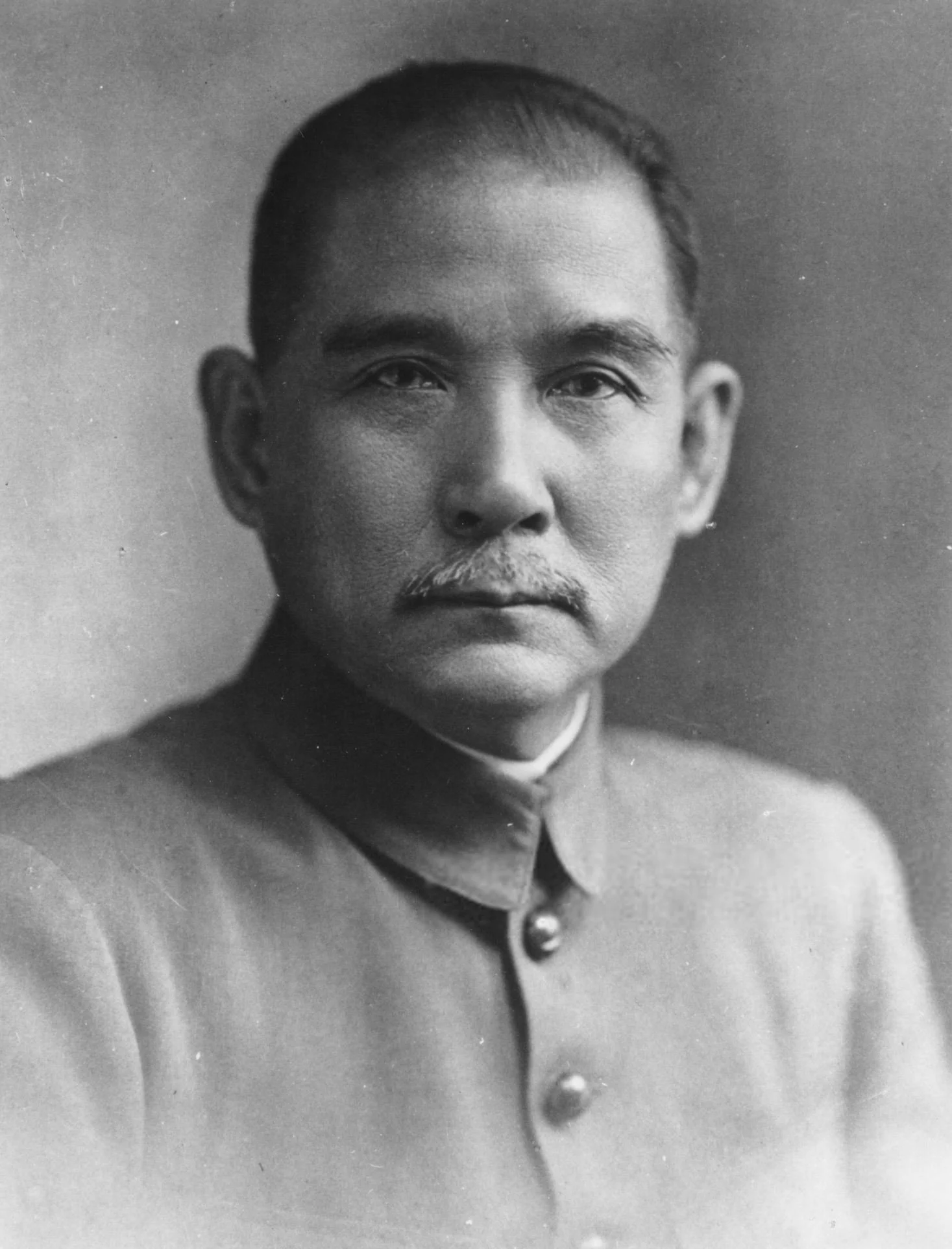
Sun Yatsen / Sun Yixian
1866 - 1925
Opposed the Qing dynasty, believed the only way for China to develop was to become a Republic. He studied abroad in Japan and the USA. Sun was the founder of the Guomindang (abbrev. GMD, also known as Kuomintang, abbrev. KMT) and was the first provisional president of the Republic of China.
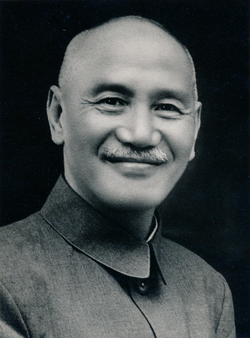
Chiang Kai-Shek / Jiang Jieshi
1887 - 1975
General and leader of the Republic of China from 1926 until his death. He led the Guomindang (Nationalists) during the Chinese Civil War, and he was known to his soldiers as Generalissimo. He joined the movement to overthrow the Qing Dynasty in 1908, and helped found the Guomindang after the 1911 Revolution (1911-1912). He became the head of the party in 1925 after Sun Yatsen’s death.
Important People
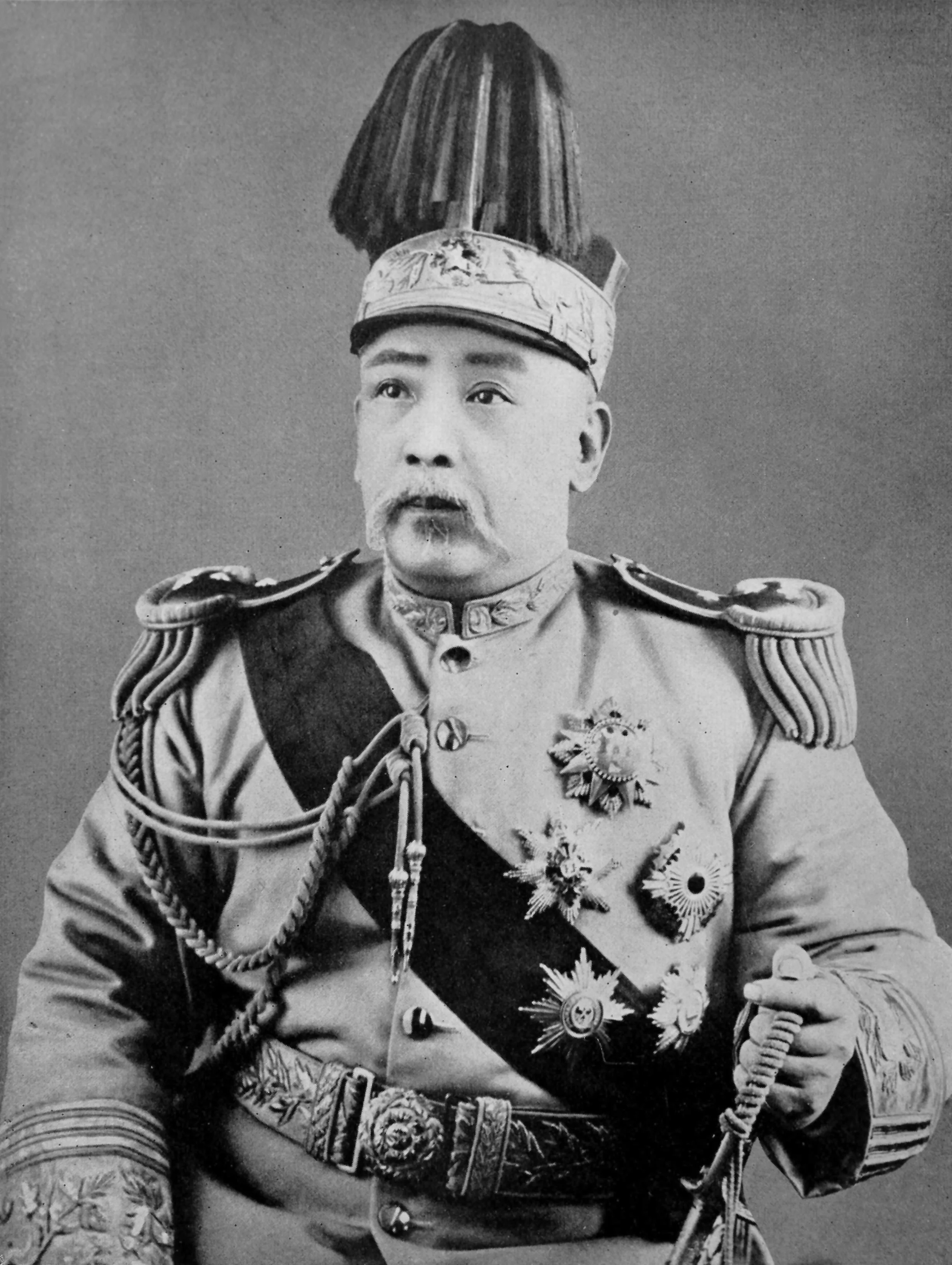
Yuan Shikai
1859 - 1916
Yuan was originally a general under the Qing Dynasty, and he built the strongest army in China after being appointed military governor in certain provinces. He used this army to pressure Puyi into resigning, and then served as second provisional president of the Republic of China, then the first official president. He declared himself emperor in 1915, then died shortly after abdicating due to pressure from rebelling warlords.
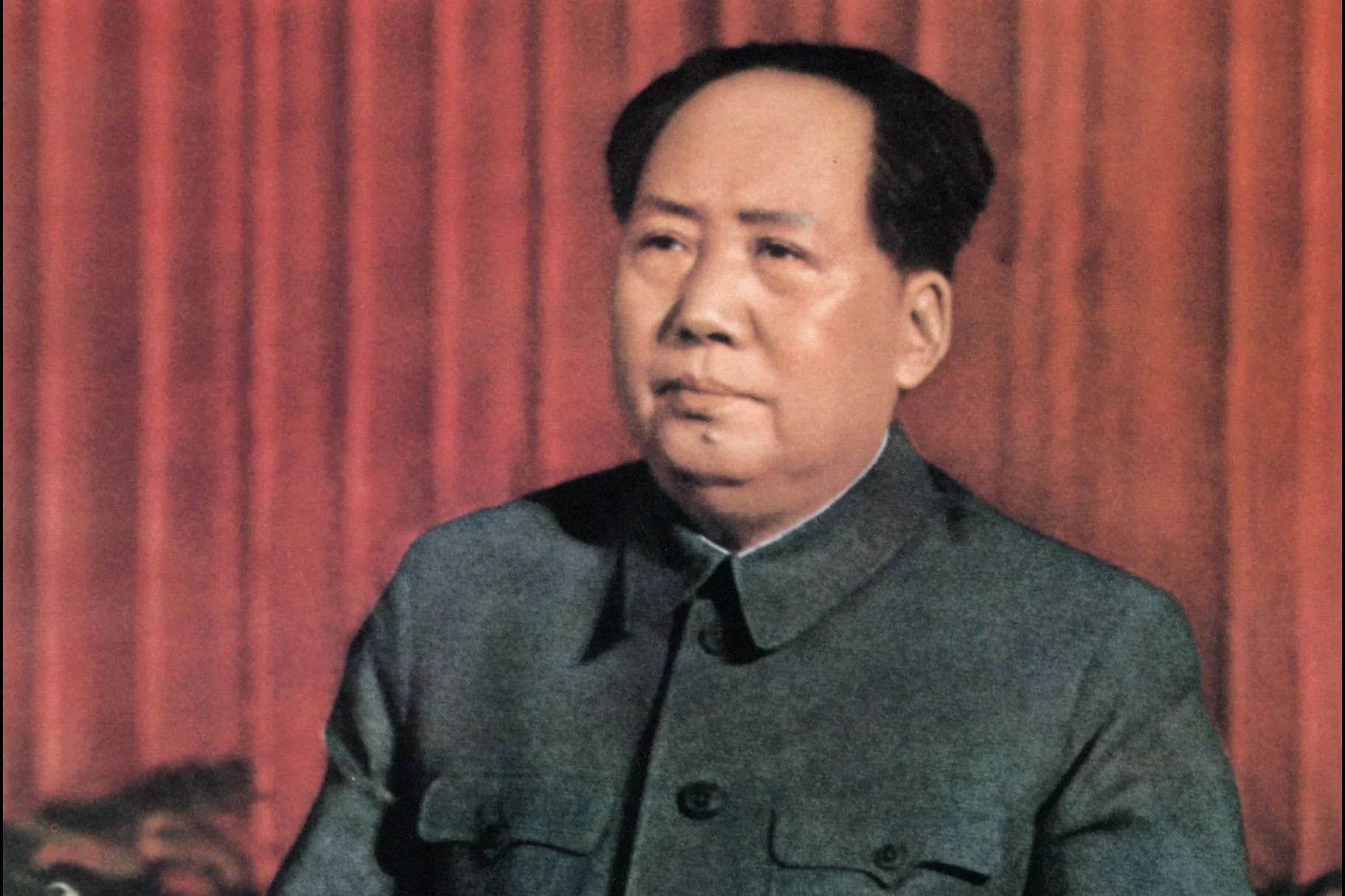
Mao Zedong / Mao Tse-Tung
1893 - 1976
Born to a peasant family, Mao took part in the 1911 revolution and the May Fourth Movement in 1919 as a supporter of nationalism and anti-imperialism. He adopted Marxist-Leninism while working at Peking University, and became a founding member of the Chinese Communist Party (CCP) in 1921. He became the leader of the CCP during the Civil War, and lead the Peoples Republic of China after his victory in 1949, which he led until his death in 1976.
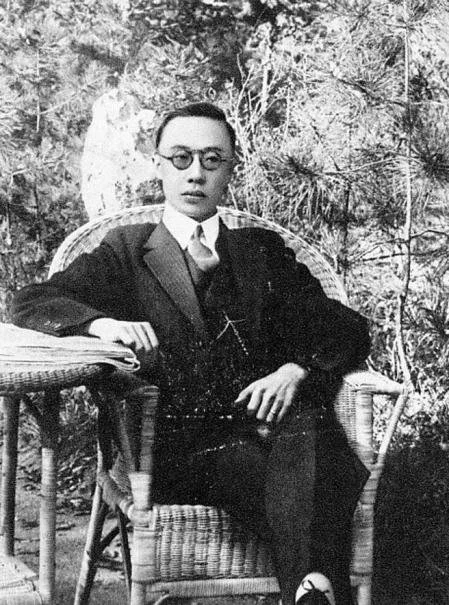
Puyi
1906 - 1967
Puyi was the last emperor of the Qing Dynasty. He was almost 3 years old when he became emperor and was 6 years old when he was forced into resigning by the Manchu army during the revolt that started in 1911.
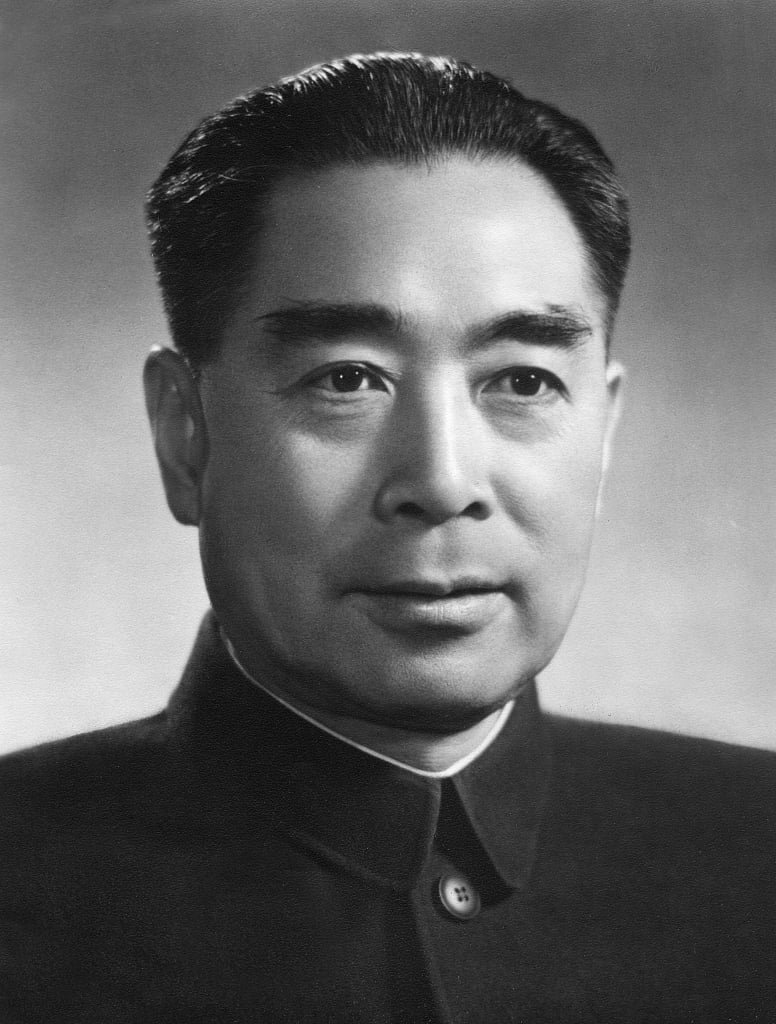
Zhou Enlai
1898 - 1976
Zhou Enlai was involved in the May Fourth movement in 1919 and spent the early 1920s studying in France. He joined the newly founded CCP in the early 20’s and became a leading member through multiple uprisings. He was beloved by the masses for his values, which was important following his death in 1976.
Causes
Economic
In 1900, towards the end of the Qing Dynasty, the majority of the Chinese population were peasants
The taxes collected from these peasants paid for the Manchu government and their imperial court
During any natural disaster such as floods or droughts, peasants faced starvation as they relied on the crop from farming to live
Peasants used farming methods that barely left them with enough crop to feed themselves and their families
80% of
Population grew by 8% between 1850-1900, but the cultivated land only grew by 1%, and this made famines more frequent
~88% of the population were peasants
Peasants were frequently exploited by landlords, many peasants had their land reduced while rents were raised
Some peasants paid 80% of their crops as rent
Due to rural poverty, many peasants moved to cities, only to be met with the high unemployment that was common in urban areas
Unemployment in cities were high due to advances in technology and cheap western imports, which damaged the economy
The Manchu government was full of corruption and was unable to help the inflation crisis, which weakened its position as the sovereign power
Corruption in the local and provincial governments often meant revenue from taxes did not get to the central government
Ideological
Men wore their hair in queues (large braids) as a sign of subservience to the Qing Dynasty, this led to divisions between these people and those who wanted to overthrow the regime, men were sometimes kidnapped and their hair cut
During the Manchu Dynasty, missionaries came to China in an attempt to spread Christianity, undermining the government and creating a social divide
Foreigners moved to China and created their own communities which had their own laws. These people were wealthy and did not obey China’s laws. The Chinese people did not like this and called them Foreign Devils
At the beginning of the 1900s, many believed the Qing Dynasty should be overthrown so China could become westernized and industrialized with a democratic government
Many people in China maintained Confucian values, which entailed a respect of authority and putting the group over the individual, which meant China was not primed for the type of democracy the Republic was attempting to create
People were used to authoritarian leaders over pluralistic governments, which meant that the Republic struggled to gain support and an authoritarian government such as Mao’s had more success
This can be compared to the Weimar Republic in Germany, where the people weren’t used to democracy and thus traditional values prevailed
Long-Term Political
In 1908, the brother of the former emperor Prince Chun, who ruled as a regent, dismissed Chiang Kai-Shek as a troublemaker, which humiliated him
Prince Chun increased taxation, which only served to anger the business class without making socio-economic progress
In November 1911, during the Revolution, delegates from the various independent provinces in China (who had declared independence at the start of the revolution) met in Nanjing to declare a Chinese Republic, and invited Sun Yatsen to be its first president
The Qing government attempted to use General Yuan Shikai to suppress the revolution, but he double crossed them by making a deal with Sun for Yuan to become the first president of the Republic
This republic had various problems, which undermined its effectiveness, there was no real democracy, the revolution was not led by the middle classes but was led by the military, and most imperial officials kept their positions
Sun then fulfilled his deal and handed the presidency to Yuan, some believe he did this in order to prevent a civil war as the Republicans were not powerful enough to defeat Yuan’s military
Guomindang was founded in 1894 in Hawaii by Sun Yatsen, but he took it back to China when he returned in 1911, and he reformed it into a parliamentary party in 1912
The GMD was set up under Sun’s “Three Principles”; Nationalism and the destruction of foreign influence, democracy and education so the people would rule, and the redistribution of land to peasants and economic development
Yuan Shikai rules as a military dictator between 1912 and 1915, but the issues that led to the revolution such as regionalism (provinces were independent) remained unsolved
Yuan consolidated power despite Sun’s attempts to reduce it by moving him to Nanjing, as Yuan refused to leave Beijing, and Sun fled to Japan in 1913
Yuan declared himself emperor in late 1915, which was met by serious backlash from the army, and he stepped down and died soon after
His legacy created instability and corruption within the new Republican government
Short-Term Political
Warlord Era (1916-1928)
After the Double Tenth Rebellion, China became divided into warlord provinces who acted independently from another
Began after Yuan’s death, but was created in the revolution as provinces declared independence and fought against the Dynasty with their own armies
Warlords were the leaders of their own provinces, they imposed their own laws and currencies and collected their own taxes, the warlord provinces each had their own private armies
The warlord era essentially brought anarchy, there was no national unity and this embarrassed many Chinese people, who would then lean towards the GMD or CCP
May Fourth Movement (1919)
Began as student-led mass demonstrations in Beijing against the warlords, traditional Chinese culture, and the Japanese
People were angry at the Versailles settlement, as they did not get land that was rightfully Chinese
Imperialism was seen as a major problem in China, many people were against imperialist powers
This was significant as it was dedicated to rebirth and change in China through unification and national identity
Some intellectuals during this time, including Mao Zedong, became determined to set up a Bolshevik-inspired government with the aim to create a socialist state, thus creating the Chinese Communist Party
Sun Yatsen dies in 1925
The GMD had not made much progress towards fulfilling Sun’s “Three Principles” due to limited influence outside of southern China and their reliance on alliances with warlords, which came from their weak military
General Jiang Jieshi (Chiang Kai-Shek) became the leader of the GMD
The Soviet Union began to invest in the GMD in hopes of building a strong bond with the Nationalists
Chinese Communist Party created in 1921
Originally made of mainly intellectuals, including Mao Zedong, and had no military strength
The CCP was anti-imperialist and advocated for the destruction of warlords and the unification of China
Due to its lack of military, some shared values, and encouragement from the USSR, the CCP agreed to work with the GMD
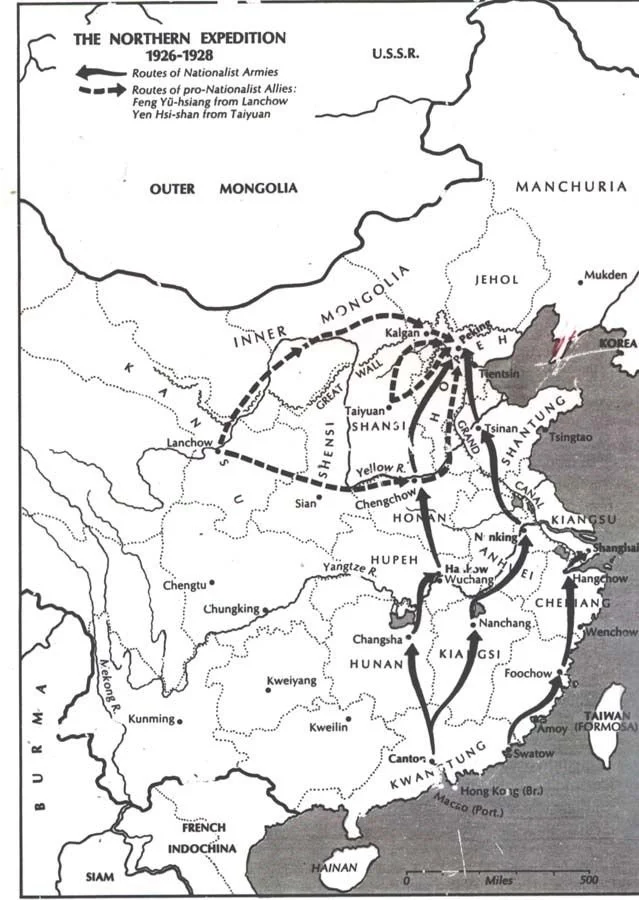
Map of the Northern Expedition (1926-1928)
Important Events
1911 Double Tenth Revolution
China had been ruled by the Manchu-led Qing Dynasty since 1636, meaning the Chinese people were under a 275 year dynasty that was facing political chaos by the end
This revolution aimed to overthrow the Qing Dynasty and establish the first Chinese Republic, which was ultimately successful
The Republic, however, was not successful as it still faced political chaos and exploitation from foreign powers, it lacked a strong central government
The Qing government tried to use General Yuan Shikai to suppress the rebellion, but Yuan had made a deal with Sun Yatsen to become the first president of the new Republic and so he turned on the Qing Dynasty
1839 - 1860 Opium Wars
The First Opium War (1839-1842) was started by the Chinese Government’s goal to reduce opium addiction, which was being supplied by the British, which led to war between the two
Britain won the first war, demanding monetary payments, ports for trade, and the lands of Hong Kong conceded to them. Britain also became exempt from Chinese law, which worsened the divide between the Chinese people and foreigners living in China
The Second Opium War (1856-1860) was again started by a disagreement over the opium trade, which was illegal in China at the time, and included China against Britain, France, the USA, and Russia, China once again lost
These treaties were known as the ‘Unequal Treaties’ due to the exploitation from imperial powers, and led to China being divided into western spheres of influence, with them slowly exploiting China further
The treaties gave western powers control over Chinese trade, legislation, and sovereignty
1850 Taiping Rebellion (1850-1864)
Overview: A man believed he was the brother of Jesus and sought to overthrow the Qing Dynasty and spread Christianity
An estimated 20-30 million people died, mainly due to famines
The “Heavenly Kingdom” Created by the rebels, based in Nanjing, reached a population of 30 million at one point
This showed the distrust in the government and the people’s willingness to rebel
The war was won mainly by regional armies, which moved China away from centralized control and created the Warlord Era
First Sino-Japanese War (1894-1895)
Started due to disagreements between Japan and China over influence in Korea, the war was a Japanese victory and made China cede territories such as Taiwan to Japan and lose influence over Korea
Boxer Rebellion (1899-1901)
A rebellion in northern China which was against foreign powers, Christianity, and imperialism
Britain, France, Japan, Germany, and the USA (among others) fought against the Qing Dynasty and the rebels, this united force won, which was another humiliation for China
A total of 100,000 estimated deaths
World War One
Germany had territories in and around China, including the Kiautschou Bay next to the Liaodong Peninsula
When Germany was defeated in World War One and their territories taken, German territories in China were given to Japan instead of China, which was a humiliation for the Chinese people and government
The humiliation from this is a major cause of the May Fourth Movement
The First United Front
Both the GMD and CCP advocated for a unified China, and agreed to work together to defeat the warlords to unify China
First United Front was an agreement between the GMD and CCP in 1922
Both the GMD and CCP were against foreign imperialist powers in China
The USSR backed the GMD as Sun’s third principle appealed to them, it seemed to them like socialism as it aimed to redistribute land to peasants
Jiang, the leader of the GMD in the First United Front, was very anti-Communist
His first actions as leader of the GMD included removing all Communists from important positions in the party
He knew he had to unify China before he could completely eliminate Communists, so he agreed to ally with the CCP
Northern Expedition of 1926
The CCP and GMD, starting in the south of China, set out north to crush the warlords and unify China
They were very successful, they captured Hangzhou, Shanghai, and Nanjing by 1927 and took Beijing in 1928
Within 2 years of the start of the Northern Expedition, the warlords were mostly gone and the GMD announced that it would be the legitimate government of China with their capital in Nanjing
End of the First United Front
China was not unified, as the only reason the alliance between the GMD and CCP existed was finished, the warlords were gone
The Communists had promised land to peasants if they came out victorious, which gained peasant support for the Communists
Zhou Enlai, who was a Communist within the GMD at the time, organized a workers uprising in Shanghai, showing the divide between Communists and Nationalists
Jiang decided he had to destroy the CCP as they were becoming too popular, cooperation was finished
The GMD’s support mainly came from landlords and the wealthier middle classes, and so the Communists promises of land redistribution clashed with the GMD’s goals which favored the landlords
Jiang rid the GMD of all Communists and began attacks on them
In April 1927, before the Northern Expedition was over, Jiang turned on Zhou Enlai in Shanghai in what was known as the “White Terror”, GMD armies massacred his worker’s army, killing around 5,000 Communists
The White Terror was known as the ‘purification movement’, thousands of Communists, trade unionists, and peasant leaders were killed. In total, around 250,000 people were killed in the White Terror
The CCP fled to the mountains of Jiangxi (A province in southern China) despite orders from the USSR to maintain the United Front, and the Communists knew the GMD would destroy them otherwise
This officially began the Chinese Civil War as the GMD followed the Communists as they fled into the mountains and created the Jiangxi Soviet
Chinese Civil War Stage 1
Communist Jiangxi Soviet
The Jiangxi Soviet was set up in the Jiangxi Province with the help of the Soviet Union, with Ruijin as its capital on November 7, 1931
The Soviet was set up with the Communists' ideology, which influenced policies such as land redistribution, cancellation of debts, workers rights, pay raises, and the trial of Nationalist officials
These policies helped gain the support of the local people, who then supported the Red Army either through supplying it or joining it directly
During this time, Mao refined his ideology and teachings, focusing on the importance of peasants and rural areas over the urban cities
The GMD had much support from the 12% of the 500 million Chinese population that lived in urban areas, Mao decided the 88% were more vital
Mao shifted away from traditional Marxism, which caused clashes with the more orthodox CCP members, but his successes in organizing peasants increased his status and support
This unique ideology caused divisions within the CCP, especially since the USSR did not share these ideals. In February 1930, a Comintern (Communist International) official named Li Lisan ordered the CCP to attack cities in Jiangxi and Hunan
This was known as the “Li Lisan Line”, and all attacks failed, resulting in Communist losses and retreat, and they lost influence over cities in these provinces. Li Lisan was dismissed from his leadership position in the CCP in January 1931
Li was replaced with a group of graduates from universities in Moscow known as the ‘28 Bolsheviks’, who served a leadership position within the CCP and had the power to dismiss Mao as chief commissar of the Red Army, Mao saw them as inexperienced
Jiangxi is a mountainous province, so GMD forces had difficulties winning battles against the CCP’s guerrilla tactics
While the GMD was preparing and carrying out the Five Encirclement Campaigns, the CCP was focused on building up a military force
This military was known as the Red Army, and would later become the People's Liberation Army (PLA) after the war
“The enemy advances, we retreat; the enemy halts, we harass; the enemy tires, we attack; the enemy retreats, we pursue” - Mao, 1929, in a letter to Li Lisan
Communist Guerrilla Tactics
Definition: “Guerrilla warfare is a form of unconventional warfare in which small groups of irregular military, such as rebels, partisans, paramilitary personnel or armed civilians, use ambushes, sabotage, terrorism, raids, petty warfare or hit-and-run tactics in a rebellion, in a violent conflict, in a war or in a civil war to fight against regular military, police or rival insurgent forces.”
Guerrilla tactics used by the Communists were important to winning battles
They would hide in the mountains, allow the enemy to advance, then move behind and cut the army off from supplies and the rest of the army, allowing them to be quickly destroyed
As the Guomindang was a traditional army, they were not trained to deal with tactics such as this, they were trained to fight European-style wars such as trench warfare
General Peng, a Commander of the Red Army made an account to American Journalist Edgar Snow, saying:
“There are certain rules of tactics which must be followed if the newly developing partisan army is to be successful. First, partisans must not fight any losing battles. Unless there are strong indications of success they should refuse any engagement.”
“Second, surprise is the main offensive tactic of the well-led partisan groups. Static warfare must be avoided. The partisan brigade has no auxiliary force, no rear, no line of supplies and communications - save that of the enemy”
“Third, a careful and detailed plan of attack, and especially of retreat must be worked out before any engagement is offered or accepted. Superior maneuvering ability is a great advantage of the partisans.”
“Tenth, besides superior mobility, the partisans, being inseparable from the local mass, have the advantage of superior intelligence, and the greatest use must be made of this…”
“Finally, it is absolutely necessary for the partisans to win the support and participation of the masses”
The tactics the Communists used are as such:
Bases: The Communists set up ‘base areas’, which were small command posts where local peasants would be organized and taught Communist ideologies. The hope was then that they would embrace CCP tax and justice systems as the new ones would be better than those of the previous regimes. The use of Mao’s 8 Rules of Discipline (See below) was important for gaining the support of the locals
Organization: Once a command post was organized, CCP officials would go to other villages to repeat the process and they slowly covered much of the countryside and influenced the people
Defense: The GMD would frequently attack CCP bases, especially when the locals began paying taxes to the latter. Mao taught the peasants hit-and-run guerrilla tactics, where the peasants would lure GMD units into traps where they would then be attacked by a band of guerrillas, who would then disappear into the local community. Their knowledge of the local terrain was vital for this. If the GMD tried to attack villages in order to destroy the CCP influence, they would face backlash from the locals and a drop in support in the area
Mao knew that his guerrilla tactics would make the war last longer, but he knew that as they continued to spread and gain more influence, their army would grow stronger until it could finally overcome the GMD completely
Mao’s 8 rules
1. Be polite when speaking
2. Be honest when buying and selling goods
3. Return all borrowed items
4. Pay compensation for anything damaged
5. Do not hurt or swear at others
6. Do not damage crops
7. Do not harass women
8. Do not mistreat prisoners
These rules helped guide the Red Army in a way that appealed to the peasants that were, in most cases, supporting the army through crops and living spaces, which increased support in areas the CCP spread into
These rules also increased the likelihood of GMD soldiers defecting
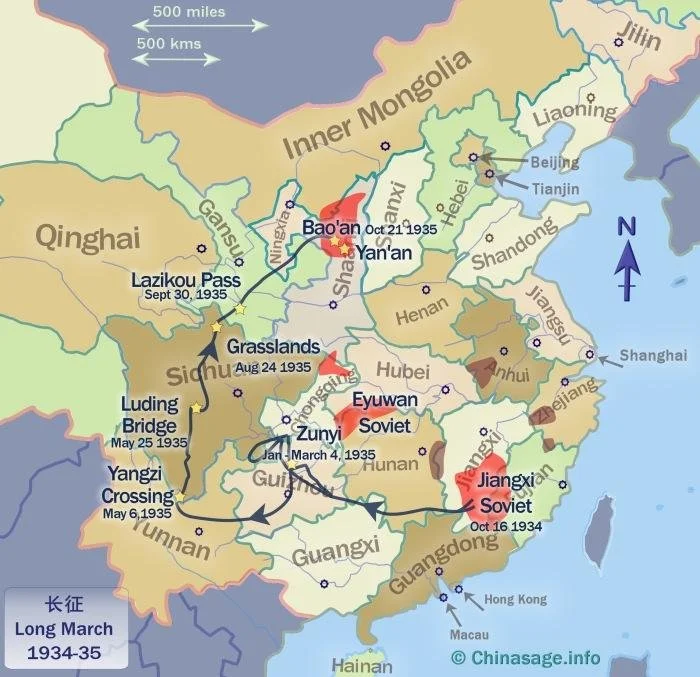
Path of the Long March
How did the CCP survive from 1927-1937?
CCP Successes
Their ability to endure the Long March and the perils from that meant that those who survived formed somewhat of a brotherhood, making them a more coherent army
The Long March also spread CCP influence across rural areas
Mao’s consolidation of his leadership position was important, as his ideology and strategic planning allowed the CCP to both survive and expand
The CCP’s ability to win the support of the local people was vital as they provided supplies and soldiers
Mao offering an alliance to fight the Japanese helped elevate the party’s social status
GMD Errors
Deciding to focus on the Communists instead of the Japanese lost them crucial support
Their inability to stop the CCP in the first weeks of the Long March, especially at the Luding Bridge, meant they lost opportunities to end the war quickly
Their mistreatment of local peasants also lost them support, which made camping in rural areas more difficult
They failed to follow Sun’s Principles, which meant they were not following the ideology they were known for
The Long March
In October 1933, Chiang launched the 5th encirclement campaign, in which they used tactics suggested by a German general of gradually advancing and building forts along the way and brought 800,000 men
In the final campaign, the CCP could not overpower the GMD’s army, artillery, and air force, and thus were outmatched and lost their final battle at Ruijin in 1934
The Communists had also changed tactics before the 5th campaign in favor of facing the GMD head-on, Mao objected this decision, and the fifth campaign was a disaster for the CCP. Mao took part of the Red Army and used old tactics to escape by forcing through enemy frontlines
Furthermore, the CCP lost because they had worse supplies. Their weapons were outdated, they had no artillery or air force, and they had low-quality medical equipment. The CCP couldn’t sustain itself under these conditions
Communists were also losing support from local peasants due to the increasing violence and the effect it had on farming and quality of life, meaning they were losing benefits from local support
Mao knew the CCP faced destruction, and the only way to escape was to break through GMD lines and flee Jiangxi. This was started on October 19, 1934 and started what was known as the Long March
Mao took 90,000 Communists on a trek across China that lasted 368 days and spanned 9,600 kilometers to Shaanxi. 90% of the Communists that escaped the GMD and embarked on this journey perished, leaving only 9,000 Communists remaining in the army
The GMD pursued the CCP the entire time, the CCP took routes through mountains, plains, and swamps. Many died from freezing, falling off cliffs, or falling into mud and suffocating/drowning
Crossing the Xiang River - November-December 1934, The GMD heavily fortified along the Xiang River in an attempt to cut the CCP army off from escape and destroy them. The Red Army was led by the 28 Bolsheviks, who led the army directly into the river, where 50,000 were killed by the GMD. The Red Army was weighed down with furniture and other supplies and didn’t use Mao’s guerrilla tactics, causing a disaster. This event was important in discrediting the 28 Bolsheviks and consolidating Mao’s power
Zunji Conference - Jan 1935, the CCP captured the town of Zunji using guerrilla tactics and held a meeting to determine the party’s future. The 28 Bolsheviks had been discredited, and during the conference Mao established a stronger control, which helped the party in the coming years
Upper Yangtze River Crossing - Mao had ordered the army to march north to fight the Japanese at the Zunji Conference, and so his army went towards Sichuan to combine with Zhang Guotao’s army of 40,000 soldiers. The GMD followed them across Yunnan and Tibet, and destroyed all boats at the Yangtze River Crossing so they couldn’t escape. Mao made Chiang think the Communists were building a bridge at the crossing, but sent his army 136 kilometers up the river and built a bridge there, and thus his army escaped
Luding Bridge - In May 1935, Mao was moving his army quickly, covering 134 kilometers in 24 hours, and reached the Dadu River, where the locals had built a bridge with their own resources. The river moved rapidly, so this was the only way to cross. The GMD, in a strategic mistake, did not blow up the bridge, though doing so would have angered the locals. The GMD removed the wood from the chain bridge and defended the opposite bank. According to the CCP, 22 volunteers clung to chains and crossed the river under fire from machine gun posts. They took out the machine guns, but only 5 survived, and the CCP replaced the boards and crossed. The GMD tried to burn the bridge, but it was too late.
After these events, Mao’s section of the Red Army numbered only 10,000 and they finally reached Sichuan, where he met Zhang’s army of 45,000 soldiers. Zhang and Mao argued over what the next move of the Red Army would be, with Mao wanting to go north to the Shaanxi Soviet and Zhang insisting they stay in Western Sichuan or go further west to have access to the USSR
Another leader, Zhu De, decided to go with Zhang, and both took the majority of the combined army with them. They were attacked by the GMD, who split their forces and almost completely destroyed Zhang’s army. Zhu escaped with some of the army and returned to Mao
In the final weeks of the Long March, Mao’s army had to cross the Songpan Marshes to get to Shaanxi, and this was a dangerous journey. The mud was soft and soldiers often sank into it and drowned or suffocated. Survivors said once someone sunk beyond a certain point, there was no way to save them. They also were attacked by local tribes and resorted to eating poisonous plants as to not starve. 3,000 of the 10,000 that made this 400km journey perished
The Red Army, under Mao Zedong, reached Shaanxi in October of 1935, where they set up a Communist base in Yan’an
The Second United Front - End of the second stage of the Civil War
In 1931, Japan launched a full-scale invasion into China, moving south from Manchuria (Second Sino-Japanese War). Instead of turn to fight the Japanese, Chiang ordered his army to not resist and instead retreat, and to focus on destroying the Communists
“The Japanese are a disease of the skin, the Communists are a disease of the heart” - Chiang Kai-Shek (1941)
Chiang’s refusal to fight the Japanese made many Chinese people angry, as Japanese soldiers were ravaging China by burning villages, destroying cities, and raping, torturing, and killing civilians
Many Chinese people from the north fled south towards Yanan, many of them met with Communist forces in what was called the Yanan Spirit
As the Japanese advanced, the Chinese people put increasing pressure on Chiang and the GMD to do something about them
The Communists offered an alliance with the GMD in order to fight the Japanese, which Chiang initially refused, despite public support from those who had been effected by the Japanese invasion. The Soviet Union also supported this alliance, as they were worried of what Japanese occupation of China could mean for their influence
In December 1936, Chiang was kidnapped by his second in command Zhang Xueliang in Xi’an, where he had been planning another assault on the CCP. This came from a growing sentiment within the GMD army’s command to unite with the Communists to fight Japan. Chiang was held hostage during negotiations with the CCP and was forced to make an agreement at gunpoint
Chiang was released 13 days after his capture on 26 December 1936 on Comintern orders, though some of his captors wanted to kill him
The Second United Front was officially formed in April 1937, and the Chinese Civil war was put on hold
The CCP benefitted from this in multiple ways, mainly that it gave them legitimacy and allowed them to regroup and resupply, which was imperative for the later phase of the civil war
Weaknesses in GMD Tactics before Long March
According to Zhu De, a military strategist for the CCP, the “Guomindang armies all fought by the usual Japanese military tactics… we split up into small, swift combat units which got in their rear and on their flanks, and attacked, cutting them into segments… they failed because such guerrilla warfare requires not only a thorough knowledge of the terrain of the battle area but also the support of the common people”
The Guomindang didn’t know much about the local terrain, while the Communists did as many of the soldiers were peasants who came from these areas
They lost popular support through multiple errors, mainly not focusing on the Japanese and exploiting peasants
Much of the GMD’s support came from landlords and the rich in cities, which limited initiatives to infrastructure projects, which combined with his lack of reform to improve democracy to mean he had little support outside of cities
Chiang launched the “Five Encirclement Campaigns” which aimed to encircle and destroy both the Jiangxi Soviet and the CCP, these started in 1930
The first 3 were executed between December 1930 and September 1931, with increasing forces of 100,000 men, 200,000 men, then 300,000 men - All 3 were defeated by the Communists using guerrilla tactics, as the GMD did not improve upon their strategy
The CCP allowed the GMD to come in and begin to round up communists, before then attacking their armies as they were scattered. The Communists’ knowledge of the terrain was especially useful here
In the fourth campaign, Mao was not involved, but Zhu De used the same tactics as the first 3 campaigns to win against the GMD again in March 1933
There were many divisions in the GMD, especially between leadership and the soldiers
Soldiers were often conscripted and faced poor conditions, and thus desertion was common
Soldiers weren’t paid much, if at all
During the nights, soldiers were chained together to prevent them from running away
Those who did manage to escape often went to the CCP with information and supplies
Chiang had to deal with the Japanese invasion of Manchuria in 1931, which he handled poorly by allowing the Japanese to invade so he wouldn’t have to take focus off the Communists
Second Sino-Japanese War
End of the Second United Front
The Second United Front lasted from December 1936 until March 1947
Despite the alliance and both armies fighting the Japanese, GMD and CCP forces frequently fought each other for influence and resources in certain regions, especially in the areas that weren’t ruled by either side, the Japanese, or warlords. These areas were known as “Free China”
The CCP began recruiting independent guerrilla forces that were made to fight the Japanese in 1938. Those who didn’t agree were attacked and destroyed
In 1937, the CCP established the New Fourth Army as a part of the Second United Front. In December 1940, Chiang Kai-shek ordered their evacuation from the provinces of Anhui and Jiangsu, but the army commanders advanced their soldiers and did not evacuate by the given deadline
The CCP attacked GMD armies in Hebei in August 1939 and in Jiangsu in October 1940, and in retaliation the GMD surrounded and destroyed the New Fourth Army’s headquarters in January 1941. This was known as the New Fourth Army Incident
This served to weaken the CCP, but they were not completely destroyed and the CCP announced it would rebuild the army
This effectively ended large-scale cooperation between the CCP and GMD
While fighting the Japanese, the GMD and CCP fought each other, and the CCP either absorbed or destroyed the GMD’s civilian forces
The CCP focused on building its influence wherever possible through mass organizations, administrative reforms, land reforms, and tax reforms, in rural areas, this helped the local peasants and grew the CCP’s support and influence
The GMD allocated army divisions to blockading the CCP in an attempt to prevent its influence from spreading
Japan was eventually defeated in the Second World War and withdrew from China completely, leaving the GMD and CCP without a common goal and leaving Manchuria as a region both sides wanted to influence
Mao and Chiang tried to negotiate peace and an end to the Chinese Civil War with support from the USSR and the USA, but this was unsuccessful, and the Second United Front ended when full-scale war began again in 1946
The CCP and GMD raced to Manchuria both to influence the region and to take supplies the Japanese had left behind, a race which the CCP won. This gave them badly needed supplies which were then used to fight the GMD
The CCP during the Sino-Japanese War
Mao’s policy put the focus on expansion, with secondary priorities being the GMD and Japanese. Through this, they liberated hundreds of rural towns by March 1945, implementing CCP policy in them
Implemented land reform, made schools, spread communism, reduced taxes, abolished debt
From 1939, the GMD blockaded CCP territories in an attempt to starve them out. This forced the CCP to be self-sufficient, which impacted policymaking
The CCP began taxing people on goods to reduce inflation
Officers and soldiers were made to work on farms to contribute to agricultural output
This worked to a certain extent, as the CCP managed to survive this
“By 1945 about 40% of their basic needs were survived this way” Jack Gray
Rectification Campaigns (1941-1944) - Teach Mao thought to all members, any deviation must be fixed
This removed opposition by purging anyone from the party that had differing beliefs from Mao, such as pro-Russian factions within the party
These campaigns followed the main ideals of conformance, Mao’s peasant-based ideology, and guerrilla warfare strategies
Many were accused of being class enemies and spies, including some educated Chinese people who had hopes of helping the revolution
CCP guerrilla attacks on the Japanese were used as propaganda, promoting the CCP as the real nationalists as opposed to the GMD, as the Communists were the ones really defending China, according to the propaganda
CCP propaganda also villainized Chiang by saying he was receiving support from the USA and thus he was a puppet of western imperialist powers, which fed into the hatred of foreigners that many Chinese held
Effect of the Second Sino-Japanese war on the GMD
Following its capture on December 12, 1937, the capital of China, Nanjing, was ravaged by the Japanese. The soldiers looted, burned, massacred, and raped the city, this event is known as the Rape of Nanjing. Over 200,000 Chinese were killed and between 20,000-80,000 women were raped. Due to faults in Chinese command, the defenders capitulated quickly and many were killed. This was not an isolated event, but happened across northern China, which lowered trust in the GMD as the party was not able to halt their advances
The Japanese successfully took Shanghai in 1937 after a 3 month-long siege which heavily damaged the city and left between 200-300,000 Chinese dead
In June 1938, in an attempt to slow the Japanese advance, the GMD intentionally blew up a series of dams holding the Yellow River, creating a catastrophic flood
From this, close to 100,000 people drowned and as many as 500,000 people died in total from famines, disease, and drowning
A further 5 million people were displaced
This flood lasted until 1947
This operation did achieve the GMD’s goals, as it prevented the Japanese from capturing Shaanxi, Chongqing, and Sichuan
With much of Northern China under Japanese control from 1937 to 1945, the GMD could not collect taxes and thus they lacked funds for the war
To remedy this, the GMD began printing more money, leading to high inflation rates much like those seen in Weimar Germany
This inflation saw the savings of the middle class and workers made completely worthless, which meant they lost much of the little support they had
People used wheelbarrows to carry enough money to buy bread, stores with food or supplies had queues lasting hours, and people faced starvation
As Japan controlled key ports and supply routes, American supplies meant for the Nationalists could only be transported through the Himalayas
This meant few supplies could be sent
Despite American financial support and aid, the GMD was very corrupt and money typically disappeared and the army saw no improvements, meaning the armies were still underfunded and lacked proper supplies
The failures of the GMD during this time reflected poorly on Chiang, with many officers being discontent with his leadership
This led to factionalism within the GMD, which lowered stability and made the situation worse for the party as a whole
Chiang responded to factionalism with increased repression, which made both the armies and the civilians more hostile towards the GMD
The GMD was unable to establish control in northern regions after the war ended, which allowed the CCP to gain influence over economically valuable areas
The GMD was fighting the Japanese with traditional tactics, resulting in heavy losses. On the other hand, the Communists continued to use guerrilla tactics against the Japanese, which meant their losses weren’t as severe
The GMD took most of the attacks during Japan’s initial invasion, which meant they lost valuable supplies and local support
Many Chinese felt the GMD was waiting for the Americans to defeat Japan and end the war, which made them angry at the government
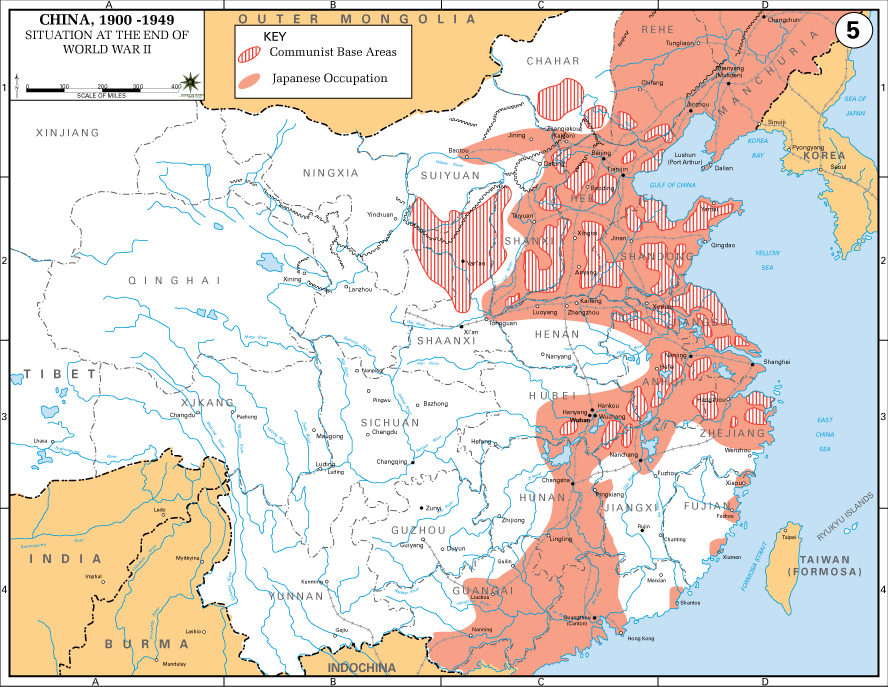
Extent of Japanese control over China
Civil War Phase 2
War for the CCP
1945-1946
The CCP acquired much needed supplies that the Japanese had left as they fled, these supplies allowed the Communists to continue the war despite the GMD’s blockade
As they were significantly stronger, both from the supplies and from the fighting experience, the CCP switched to a more conventional form of warfare from their usual guerrilla tactics
In 1945, the GMD’s 4 million troops outnumbered the CCP’s 4 to 1
The CCP clearly had the support of the Soviet Union, as the USSR supplied them with Japanese supplies, which was very helpful to the Communists
Much of Manchuria is flat, and it was unknown territory to the Communists, meaning they could not employ their typical guerrilla tactics while fighting the GMD
After failures in Manchurian cities, Mao decided to return to his policy of making rural bases in December 1945
Initial CCP failures also lost them some rural support, as many were not ready to support the Communists’ violence that only resulted in defeat
In March 1946, the GMD controlled central Manchuria. The CCP called for a ceasefire and condemned the US’s support of Chiang
Mao gained support through “Struggle meetings” where peasants would accuse landlords of exploitation and mass peasant mobs would kill landlords
In 1947, Mao urged restraint as he was worried the revolution would get out of control and have negative effects for the CCP
The violence of these meetings scared other groups of peasants off from supporting the CCP, so the Communists had to work on rebuilding their support base
1947-1949
The truce Chiang agreed to helped save the Communists, as they trained troops and introduced land reforms in the areas they controlled. The land reforms increased peasant support as they saw Communist victory as a way to keep land
The CCP’s Red Army was renamed to the People’s Liberation Army (PLA)
The PLA once again managed to effectively use guerrilla tactics against the GMD, cutting off their supplies and armies by targeting railways
The CCP evened the fight in terms of military power and resources around March 1948, and the balance of power had began shifting towards the CCP since the PLA had more heavy weapons
The CCP was able to take Manchuria by the end of the month
After their victories from March 1948, Mao proclaimed the People’s Republic of China in a ceremony in Beijing on October 1st, 1949, with the words, “Our nation will never again be an insulted nation. We have stood up”
CCP Strengths
Guerrilla tactics
The successful use of guerrilla tactics in the first phase of the war allowed the CCP to survive despite odds being against them
Their tactics also allowed them to build support and influence in rural areas
Guerrilla tactics against the Japanese between 1935 and 1945 helped build strength and train peasants to fight against a superior enemy
Despite initial failures in the second phase of the war, the return to guerrilla tactics allowed them to regain ground against the GMD and ultimately push them out of Manchuria
Leadership
Initially, the CCP leadership structure was chaotic, such as Li Lisan and the 28 Bolsheviks, leading to some defeats. However, once Mao gained charge at the Zunji conference, military strategy became much more organized and allowed them to survive the rest of the war
The guerrilla tactics Mao insisted on using were vital to CCP survival
Mao took advantage of the Japanese invasion to both improve their status by calling for an alliance and to train soldiers to later fight the GMD
Despite his frequent attacks of the bourgeoisie or middle classes, during the Japanese invasion he called for collaboration between all classes across China, invoking nationalist sentiments among people
Mao made the Communist party appear more nationalist than the GMD by demanding cooperation for the good of the people and through propaganda, which attracted those who felt humiliated since 1900
Mao’s effective use of propaganda was vital to maintaining army morale and gaining support from rural areas
Many peasants were unable to read, and so Mao’s propaganda mainly used imagery to convey the ideas, which made them more accessible and thus reached a large audience
They portrayed Chiang and the GMD as American puppets, which angered nationalist Chinese people
Lin Biao was an excellent commander and leader of the Red Army/PLA, he transformed the PLA into a regular army from a guerrilla army once it was more effective to use traditional tactics
The PLA was in part supported by GMD soldiers who deserted their army, bringing the CCP resources. Many in the PLA joked that Chiang was the largest supplier of American weapons to the CCP
As the PLA had better conditions than the GMD’s army, CCP morale was higher and they fought much more effectively than the GMD’s troops, who were often tired, starved, and scared
The PLA did not mistreat local peasants, which helped build support
Mao’s rectification campaigns removed opposition, increased cohesion, and consolidated Mao’s role as party leader, allowing him to enforce his tactics
Ideology
CCP policy involved land reformation, where the peasants would seize land from landowners in Communist-controlled regions. The peasants would then support the CCP as the only way to keep this land was through a communist government
The Communists effectively spread their ideology in rural areas through propaganda and sending officials to local villages to preach to the people there
Influence of Communist ideology massively supported CCP war efforts, as the peasants were vital in supporting and growing the Red Army
Communist ideology appealed to most peasants, as they had been exploited for decades by governments and landlords, and thus the idea of land redistribution was attractive to these people who had faced starvation
Spies
The CCP was much more effective in using spies to gain intelligence than the GMD in the second phase of the war
Many people within the CCP were accused of being spies, which did serve to catch real spies but also deterred potential spies. The GMD was unable to make a meaningful infiltration into the CCP
The Assistant Chief of Staff to Chiang Kai-shek, Liu Fei, was a CCP spy. His position as the head of the GMD’s War Planning Board meant the CCP was aware of GMD attacks before they happened
Some Nationalist commanders were actually Communists in disguise, and they intentionally sabotaged their armies to help the Red Army win key areas
War for the GMD
1945-1946
In the first phase, the war was contained within China. Once the Cold War began, the Chinese Civil War became an international affair as the war fell under American and Soviet influence
Chiang believed his GMD was strong enough to fight the CCP, and thus made no effort to maintain the agreement and increased his attacks against them
The GMD saw initial success due to superior supplies and more troops, which forced the CCP to play defense
Due to the CCP being unable to use guerrilla tactics in Manchuria, the GMD quickly captured major cities
Despite winning Manchuria early on, the way they governed it ultimately led to their downfall.
They governed it with the same conditions they had other regions during the war with Japan
The GMD did nothing to improve corruption, and thus the Manchurians living under a corrupt government were encouraged to support the CCP
1947-1949
The GMD captured more cities in Manchuria and captured Yan’an, which had served as the CCP’s capital, in March 1947
Chiang had refused foreign advisors’ pressure to withdraw from Manchuria, which lost him 40,000 troops and control of Manchuria by the end of March 1948
Chiang made the mistake of overextending his forces in Manchuria, which the Communists exploited through major offensives, pushing the GMD back
After March, the CCP switched to conventional warfare which relied on heavy artillery and attacked an important railway junction in Xuzhou, the Communists won this battle
This significantly weakened the GMD and lowered the army's morale, allowing the CCP to attack and capture Tianjin and Beijing in January 1949
The GMD ultimately was unable to resist the CCP, proven by a series of offensives the Communists launched in April 1949 which led to their capture of Nanjing and Shanghai, and ultimately Guangzhou in October 1949
GMD Weaknesses
Political & Economic
Chiang was resistant to democracy and became increasingly repressive of the party, which alienated many groups and weakened the government’s position
The GMD was unable to win support among most of China as they supported the landlords, who they relied on. This meant the peasants, who were the vast majority of the population, were against the GMD and would instead join the CCP
The rampant corruption within the GMD meant funds from the United States would not go to funding the army or purchasing supplies
This corruption was well-known by Chinese people, making them less likely to support the GMD
This corruption had an effect on the citizens, who were exploited by GMD officials, which further lowered support
Factory owners had to bribe officials in order to prevent their workers from being conscripted into the GMD army
The United Nations provided aid, food, and medicine for children but this was stolen by GMD officials
The middle and lower classes saw the worst effects of GMD instability, with the unfair tax system and inflation erasing many people’s savings
Despite inflation being a huge problem, Chiang only began to deal with it in 1948 by introducing a new currency and rationing, but these decisions came too late and the economy collapsed in 1949 in Nationalist areas
In 1937, one USD was equal to 2,060 Chinese Yuan. In 1948, one USD was equal to over 374 million Chinese Yuan. The GMD replaced the Yuan with the Golden Yuan in 1948
The GMD issued more banknotes in order to pay for the war, and between 1945-1948, the amount of money they had issued to pay for their war against the Communists grew from 557 billion Yuan to 604 trillion Yuan
By the end of 1948 the GMD had lost the support from business owners, which was most of the support they had left at the time
Military
The GMD was ineffective at dealing with CCP guerrilla tactics. They countered it with slow advance, but this was time consuming and expensive in terms of resources and supplies
Observers from the US noted the GMD’s army was of poor quality
The army suffered many defeats, which resulted in low morale and frequent desertions, which gave intelligence and supplies to the CCP
Unlike the CCP, the GMD strictly regulated the civilians under their control, which meant they would not grow the support the CCP did
Chiang’s leadership proved ineffective. His refusal to withdraw from Manchuria meant the GMD spent valuable resources, troops, and money on a region they could not hold
Furthermore, his decision to fight at Xuzhou proved to be disastrous, as they lost the junction, the supply route, and troops
Chiang tried to play an important role in the campaigns, but he never actually fought the battles. His interference only served to hinder the campaigns
Chiang had little support outside major cities, as his support base came from the middle classes
Chiang sent elite units northeast to fight the Communists, but failed to secure the provinces they were travelling through in the center and north of China, allowing the CCP to cut them off and destroy them
Sino-Japanese War
Some of the most skilled GMD units were destroyed fighting the Japanese in 1937 and 1938
Chiang’s inaction against the Japanese invaders undermined trust in his government and lowered morale in his army
The CCP was given supplies by the Soviets, who had invaded Manchuria before Japan’s surrender. These supplies included weapons, vehicles, heavy guns, etc.
The Soviets provided 740,000 rifles, 18,000 machine guns, 80 aircraft, and 4,000 artillery guns
Japan incurred heavy losses on the Nationalists, especially in decisive battles like the Siege of Shanghai in 1937 where the Nationalists had 250,000 casualties
Foreign Intervention
United States
In July 1944, the US army sent the ‘Dixie Mission’ to establish relations with the CCP, which lasted until March 1947
This was to determine whether it was benefitted American interests to maintain relations with the CCP by analyzing the CCP’s politics and military
The mission determined that the CCP’s territories were governed better than the GMD’s territories, with generally less corruption
This mission was then used to attempt to create an alliance between the CCP and GMD, which was unsuccessful
The US Government determined that they would not pursue the CCP as an ally after World War Two
The USA wanted to reach a diplomatic end to the war, but the GMD and CCP were not willing to work together, making much of the Americans’ efforts useless
General Marshall, part of the US Envoy to China between 1945 and 1947, managed to get the two sides to agree to begin creating a coalition government, form a temporary state council, unification of their armies into a national army, and free local government elections
As the negotiations for Marshall’s agreement were being finished, the GMD and CCP were racing into Manchuria, and the tensions between them would not allow for a diplomatic solution
This truce broke down in March 1946
The Allied commander of the Southeast Asian theater of World War Two, General Albert Wedemeyer, allowed Chiang to use US ships and planes to transport half a million troops into Manchuria during the race to Manchuria
Additionally, the US sent 50 thousand American troops to occupy Beijing
The US attempted to support the GMD with aid and money, but much of the money simply disappeared because of corruption within the government
Many accounts claim Chiang himself was not corrupt, but those in his inner circle were
The USA were split, as they didn’t want to support a single-party state but also did not want to support Communism. They continued pushing for mediation despite them sending arms to the GMD
The USA sent a total of close to $3 billion in aid, along with a large amount of arms. They also transported GMD troops and occupied cities for the GMD
In 1947 Chiang was saying US intervention was key to the outcome of the war
General Marshall was able to persuade Chiang to agree to another truce in 1947, which only served to help the Communists as they avoided a siege of their headquarters and used the time to train troops
American advisors told Chiang to retreat from Manchuria in March 1948 to preserve his army
Despite a high degree of support from the United States, the GMD was so ineffective they continually lost battles and fell apart by the end of the war
Some American observers attempted to write reports exposing the corruption within the GMD, but American media idolized Chiang, likely because he wasn’t Communist, and thus public support was for Chiang
Chiang blamed the US for his defeat as the Americans pressured the GMD into signing truces at times when continuing the fight could have proved decisive
Japan
Japan did not join the war to support either side, but did interfere in the war through their invasion in 1931, which was a vital factor in determining the outcome
Japan’s invasion significantly weakened the GMD by destroying its support, killing its army, and requiring the GMD to consume supplies they otherwise could have used against the CCP
After Communist attacks, Japan fractured their support in rural areas by burning villages and killing civilians
Japan was better at countering the CCP’s guerrilla tactics than the GMD was, and was almost able to push back against CCP attacks, but was defeated before they could turn the war around
When Japan was defeated, their army was quickly withdrawn and they left most of their supplies behind. These supplies were mostly received by the CCP and used against the GMD
Japan made Chiang divert resources away from fighting the CCP to fighting the Japanese, though not much of the total GMD army was diverted as Chiang insisted on fighting the CCP before fighting the Japanese
The Second United Front formed between the CCP and GMD to fight Japan gave the CCP time to regroup and train their army while the GMD was focused on fighting Japan, which was crucial as the CCP was on the verge of collapse
Despite widespread support, the CCP simply did not have the same weapons and supplies the GMD did
After the Japanese retreat, the CCP obtained heavy weapons that they then used against the GMD in decisive battles such as Xuzhou
Soviet Union
The Soviet Union, while supporting the CCP in some aspects, wasn’t clearly on their side. This is because of the key differences in their ideology, including who is at the center of the social revolution and who owns land
Both the USSR and USA wanted to form a coalition government between the GMD and CCP, and the USSR wanted influence in Manchuria. The United States was ready to allow this
When the CCP entered Manchuria, the Soviet Union was occupying it as per the Yalta Conference in February 1945 (US, UK, and USSR agreement where the Soviet Union would invade Japanese-controlled Manchuria after Germany surrendered). The Soviets gave the CCP Japanese supplies such as weapons
At first the Soviet Union was reluctant to support the CCP, instead believing the GMD was more aligned with their interests and that a Nationalist government in China would be more beneficial
Soviet assistance to the CCP was not on par with American assistance to the GMD
The Soviet leadership in the CCP in the initial years of the war almost led to the total destruction of the party in the final Encirclement Campaign
The Soviets supported both the first and second United Front, but Stalin did not believe that the CCP would win the war until 1948
Stalin was worried that further CCP successes would get the Americans involved further, and thus advised Mao to make decisions that would harm his war effort, but Mao ignored his advice and won the war
Effects of war
Political
Much of the GMD and its army fled to the island of Taiwan, which had recently been liberated from Japanese control
They took party leadership, military officers, and about 2 million soldiers
Chiang Kai-shek remained leader of the party, and immediately began forming plans to invade mainland China, though this never happened
They took as much of the navy and air force as they could
It is said there were an average of 50-60 flights transporting assets per day over the course of 4 months from August 1949
The GMD left their police forces in the cities, who continued fighting by murdering Communists until they were eradicated by PLA forces
The United States withdrew from the conflict and refused to recognize the CCP as the official government of China
The Republic of China in Taiwan still held its seat on the United Nations Permanent Security Council
The United States sent ships to protect Taiwan from any invasion during the Korean War in 1950
The CCP launched campaigns against those the GMD left behind, and claimed to have arrested 2.6 million people, imprisoned 1.3 million, and executed 712,000
Economic
The GMD took China’s entire gold reserves with them when they fled, along with the silver and foreign currency reserves
The GMD tried to destroy industrial sites, but local workers prevented them from doing so
Many people had been affected by hyperinflation under the GMD’s rule, the CCP had to recover the economy without any gold reserves
The CCP had to rebuild everything in China that had been destroyed, including supply routes, cities, ports, and infrastructure
“The guerrilla wins if he does not lose, the conventional army loses if it does not win”
Henry Kissinger - US Secretary of State (1923-2023)
The Communists were able to get the enthusiastic backing of the peasants through meeting their needs with reformist and radical social policies, along with defending the peasants against the Japanese
James Sheridan - American Historian (1922-2015)
Historiography
“This [crossing of the Luding Bridge] is a complete invention. There was no battle at the Dadu Bridge. Most probably, the legend was constructed because of the site itself: the chain bridge over the roiling river looked a good place for heroic deeds. There were no Nationalist troops at the bridge when the Reds arrived on 29 May…”
Jung Chang and John Halliday - Chinese and Irish Historians
“The peasants are the sea, we are the fish. The sea is our habitat”
Mao Zedong - Chinese revolutionary (1893-1976)