Nazi Germany
-
Causes of expansion: Impact of Nazism on the foreign policy of Germany; Impact of domestic economic issues on the foreign policy of Germany
Events: Germany challenges to the post-war settlements (1933-1938); German expansion (1938-1938); Pact of Steel; Nazi-Soviet Pact; the outbreak of war
Response: International response to German aggression (1933-1938); international response to German and Italian aggression
-
Methods used to establish authoritarian states: persuasion and coercion; role of leaders; ideology; use of force; propaganda
Consolidation and maintenance of power: Use of legal methods; use of force; charismatic leadership; dissemination of propaganda; nature, extent, and treatment of opposition; the impact of the successes or failures of foreign policy on the maintenance of power
Aims and results of policies: Aims and impact of domestic, political, cultural, and social policies; the impact of policies on women and minorities; authoritarian control and the extent to which it was achieved
-
Hitler’s Germany (1933-1939): Consolidation of power; Hitler’s pre-war domestic policies, including economic, social, and political policies; nature of the Nazi state; the extent of resistance to the Nazis
German foreign policy (1933-1941): Aims, issues, and extent of success
Collective security and appeasement (1914-1941): aims, issues, extent of success; role of British, French, and Russian/Soviet foreign policy (1919-1941); Chamberlain and the Munich Crisis
The Second World War: Causes of WW2 and the development of the European conflict (1939-1941)
Jump to sections
Methods used to establish authoritarian states and consolidate power
Legal methods
Nazis did well in the elections from 1928-1932, though they did lose some support in the 1932 elections
Nazis held a third of the vote in the 1932 elections, giving them the most deputies and a strong political position
(See end of Weimar section in Weimar Germany page)
Hindenburg agreed to form a new government with Hitler as chancellor under pressure from his son and army colleagues
von Papen was convinced that including Hitler in the government would mellow him out, and that they would be able to influence him.
In a letter to a friend, he stated that in two months time we will have squeezed Hitler into a corner until he ‘squeaks’
In the face of other parties fracturing and experiencing internal conflict, the Nazis enjoyed political stability and cohesion, allowing them to coordinate better and look better to the public
Reichstag fire on 17 February 1933 - Hitler claimed the fire was a signal to a communist uprising and declared a state of emergency
The Nazis used this to arrest large numbers of Communists
Introduced an emergency decree through which the Weimar Constitution was “temporarily” suspended. Hitler pledged that, “once the Communist threat is removed, things will return to normal.” This decree remained in effect until 1945
Nazi share of the vote rose to 43.9% in March 1933
In the face of pressure, the Reichstag passed the Enabling Act, giving the government power to enact laws and decrees - 24 March 1933
“It gave the destruction of the parliamentary democracy the appearance of legality” - Noakes and Pridham
Nazi party was declared to be the only legal party on July 14, 1933. Afterwards, the only separate bastions of power were the army and the President
The Nazis replaced the Weimar Legal system which promoted the rights of the people with the Nazi system which emphasized race and the community above the individual
Hindenburg died on 2 August 1934, and Hitler took the opportunity to combine the office of the Reich President and the Chancellor, creating the role of the Fuhrer
A vote was held on 19 August to approve the merging of the offices. 96% of those eligible to vote voted and over 89% approved the merger
Only 4.5 million people disapproved
Law of Restoration of Professional Civil Service - 7 April
Administration, courts, schools, and universities purged of ‘alien elements’ - Jews, political opponents, communists, etc
Employment law - 10 June - The Nazis started major public works schemes that increased their popularity
14 July 1933 - Law against the Formation of New Parties prohibited the formation of opposition political parties. As the SPD and KPD were already banned and all other parties had already dissolved themselves
14 October - Reichstag dissolved and new Reichstag to be formed
12 November - Nazi candidates for the new Reichstag win 92% of votes
April 1933 - Law for the Restoration of Professional Civil Services purged “alien elements” (Jews and political opponents) from courts, schools, and universities
Judges and other civil servants had to swear an oath to Hitler
Showing disrespect to the Fuhrer was a crime
All lawyers had to belong to the League of National Socialist German Lawyers and all teachers had to join the Nazi Teachers Association
In 1934, the Peoples’ court was set up to deal with treasonable offenses
Law for the Reconstruction of the State - Formalizes the Nazi commissioners who took power after the SA overthrew local governments
Coercion / Use of force
The Nazis used violence against Jewish communities, communists, and opposition
Boycotting Jewish shops, Stormtrooper attacks, Jews were humiliated, and Jewish books were burned
Jewish shops were marked with a yellow star or the word ‘Juden’, which in essence told Germans to avoid shopping there
Book burnings were important because it showed public supports and showed a precedent, along with the fact that students took part
It can be argued that the Enabling Act was not a legal method, but a use of coercion, as the left-wing deputies that passed the act were intimidated into doing so - The SS and SA surrounded the Opera House (Where the Reichstag was meeting due to the fire) to intimidate deputies
The SPD (Social democrats) were forcibly dissolved with the excuse that the party was “hostile to nation and state”, its leaders were taken into “protective custody"
The Nazis then went on to attack trade unions
Night of the Long Knives
Hitler launched a pre-emptive attack on the Nazi SA Brown Shirts due to an acquaintance of Hitler’s warning that they were planning a rebellion
Hitler feared that Ernst Rohm, the leader of the SA, was building an independent political force and was provoking the hostility of the army
On 30 June 1934, Rohm, other SA leaders, and suspected opponents of Hitler were murdered
von Schliecher and Strasser were killed, and von Papen was placed under house arrest
This appealed to the army as they looked down on the SA, the army celebrated Rohm’s death
The Nazi party functioned as such:
Survival of the fittest - To gain power, one had to take it themselves. If they wanted to be a leader of the local government, you had to work to get support and take the position. Few Nazis were appointed to their positions, most had to have some sort of credibility
Used terror and violence tactics to coerce people into supporting them
The administration was chaotic, Hitler often appointed multiple people to the same job to make them get in each other’s way to make the administration not powerful enough to overthrow him
Hitler was disorganized, but he usually had a team to figure things out
5 March elections, Nazis use control over radio and police force to pressure and intimidate opponents
1 April - 1 day boycott of Jewish shops
Dachau concentration camp opened on 22 March 1933, very soon after Hitler gained the Chancellorship, and sent any opposition there. This included Jews, Communists, political opposition, and anyone who opposed the empire in any way
Additionally, people could report their neighbors for opposing the Reich and they would be taken to concentration camps
Never fewer than 10,000 prisoners in the camps at a time
Total of about 225,000 Germans imprisoned for political crimes between 1933 to 1939
Discipline in these camps were brutal, with the diet being poor and the living conditions inadequate
Prisoners were made to do hard labor and were subject to beatings and torture
This was accepted by the people as Britain had used concentration camps in World War One and the Nazis were seen as a social revolution, and public sentiment was that revolutions made things better
All concentration camps had brutal conditions
Many people were accused of being homosexual and taken to camps
16 hours working a day with no water even in hot weather, insufficient amounts of food, and rations consistently lowered
Any ‘offences’ such as refusing to work or even drinking water during the working day was met with 25-60 strokes (whips) by guards, which often resulted in loss of consciousness
Soap and toothbrushes were uncommon, prisoners had very little access to water
Death was common, and the families of the deceased were told they could have the ashes of their family or friends if they paid 3 marks
The Germans established a powerful Gestapo that would patrol cities and streets crushing any opposition. They would maintain an extensive intel network that would have information on almost everyone, and if someone seemed to be opposition they’d be taken. People could report others for things as trivial as acting strange and they’d be taken. The result of this was anyone who felt like opposing would be scared into silence
The Gestapo depended heavily on reports from ordinary Germans
In Wurzburg, 54% of all race related charges were initiated by private citizens
The security service (SD) was set up in 1931 by Himmler
They would go to people’s houses at 3 in the morning, tell them to pack a bag, then take them away to prison and eventually concentration camps without trial
The SS
Created in 1925
Became more powerful after the Night of the Long Knives
220,000 members by 1935
The SS was a huge part of maintaining power in the territories the Germans conquered, as they were a strong garrison force. The SS carried out what Himmler called “the final solution to the Jewish question”.
The SS killed thousands of Jews, Roma, Slavs, Polish, and Russians from 1939 onwards
Kristallnacht - Night of Broken Glass, 9 Nov 1938
A Jewish man killed a German diplomat in Paris because he was angry at the his family was treated by the regime. Hitler agreed to let the SS loose on the Jews in Germany. Random Jewish men, women, and children were beaten and even killed, along with anyone who got in the way. The SS also destroyed houses and property
10,000 Jewish shopkeepers had their shop windows smashed and the shops looted
The SS burned houses and synagogues
The Jews were ordered to pay 1 billion marks
Jewish men and women were forced to clean streets on their hands and knees with scrubbing brushes
The concentration camps of Dachau, Buchenwald, Sachsenhausen, and Lichtenburg were expanded
Ideology
The Nazis rallied the Nationalists and anti-Semites to gain their own support by feeding into the hate through speeches, boycotts, and general violence
Rallied against the perceived Communist threat, the Nazis promised they would destroy the Communists
The main ideas of the Nazi party were: nostalgia for the old days of the Second Reich, extreme nationalism, radicalism, anti-Semitism, and the believe that violence was needed to restore order. This appealed to many Germans, as the Nazis played into these sentiments that were already felt in Germany because of the effects of World War One
Survival of the fittest-based doctrine
Many Germans were ready for extremism because of the economic crisis and collapse of the 5 major banks, some voted for the Nazis for no reason other than they felt like it
Hitler’s actions weren’t unforeseen, as he had outlined his ideals and goals in Mein Kampf
During the March 5 elections, the Nazi slogan was “The battle against Communism”
Boycott of Jewish shops gained widespread support, though it didn’t last long
The appeal to the worst side of human nature
Ever-present fear was a driver for the actions of German civilians, though the behavior was encouraged from below
German civilians enthusiastically led the Nazi salute, displaying the Nazi flag, and proclaiming “Heil Hitler” in schools, communities, and workplaces
Not following along would invite suspicion
Most people were not willing to expose themselves to potential harm, and they followed the lead of their enthusiastic Nazi neighbors who exercised strong social pressures
This enthusiasm essentially mobilized the German population to support the regime, greatly impacting their foreign policy, international image, and war effort
The regime exploited social pressures by employing spies to report on their neighbors’ behavior and conversations
Children were encouraged by their teachers to report on anything their parents said that could imply hostility to the regime
The Gestapo were always around to punish opposition
Fear of the Gestapo ensured compliance with the Nazi policies, yet the Gestapo remained as a small organization of 30,000 out of 60 million Germans
No fewer than 85% of cases brought by the Gestapo on charges of slandering the regime were initiated voluntarily by the victim’s neighbors, former friends, lovers, or fellow workers
Half of the cases resulted from voluntary denunciations
The German people were essentially policing themselves
Extent and treatment of opposition
The state viewed multiple groups as enemies
Political opponents: communists, social democrats, trade unions, and other political parties. They were put in concentration camps
Radical opponents: The Nazis saw Jews as being part of an international conspiracy. They were eventually sent to concentration camps
Opponents of ideal Germany: mentally and physically ill, euthanasia programs put in place had to be stopped due to protest. Gypsies, workshy, homosexuals, many ended up in concentration camps
How much opposition was there to the regime?
Overall impression was that there was not much and there is much evidence towards Hitler’s genuine popularity
Estimates claim that less than 1% of Germans engaged in active opposition
Any internal opposition that did exist had little effect, as it took the combined forces of the USSR, USA, and the Allies to overthrow Germany
Most Germans benefitted from Hitler’s domestic policy and thus had little reason to oppose the regime
Hitler’s foreign policy successes until 1941 reinforced public support
After 1943, public support fell due to failures
Repression and widespread denunciations made opposition a brave but stupid act, as opposition could cost your job, freedom, or life
Dilemma for civil servants who didn’t support the regime, as they had to decide whether to continue to work for the government while trying to limit its harm or to dissociate themselves from the regime
Army had been appeased by the Night of the Long Knives, and thus did not oppose Hitler
After 1934 there was no legal way to remove Hitler
When Hitler got aggressive, some upper generals in the army were cautious of him as they were scared of war and had a plan to remove him, but his successes quickly proved that there was no way to do so. These generals were removed in 1938.
Gangs of youth took part of the “swing” movement, they’d dance to American Swing music in public. While not being direct opposition, they showed signs of not conforming to the ideals of the regime
What happened to those who opposed the regime?
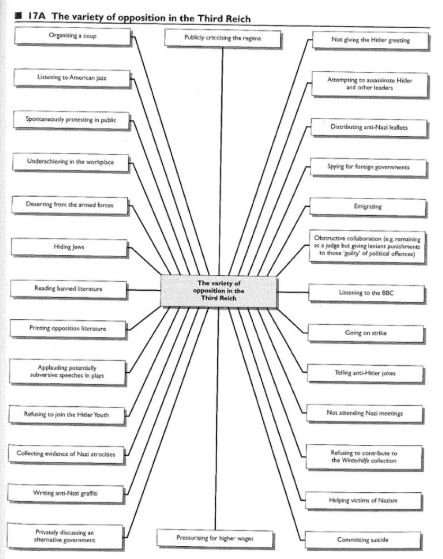
Minor opposition: Most opposition was in the form of non-compliance rather than resistance. This usually took place in private and by people with little power. The government could interpret this as opposition. Critics faced arbitrary arrest.
Estimated 1.3 million Germans who were sent to concentration camps and the 300,000 who left Germany between 1933 and 1939 also indicate there was opposition
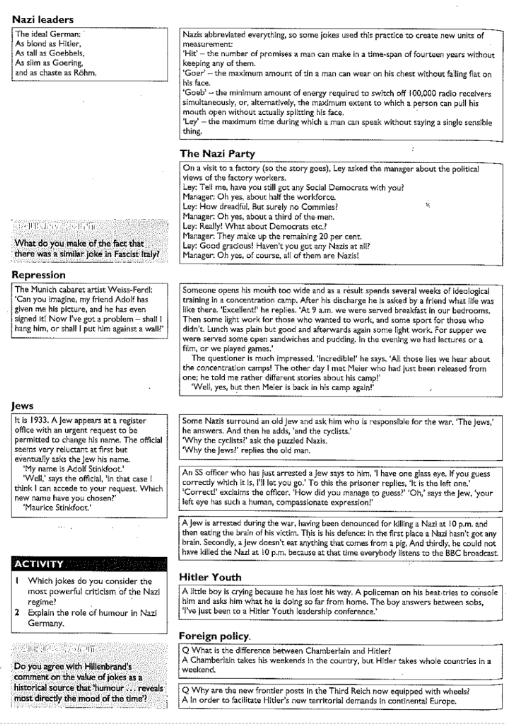
Historians have revealed that anti-Nazi jokes were popular
Major opposition: challenging the whole regime, took place in public and could involve powerful leaders. Easiest in institutions, in the army, and the church where opponents could congregate for apparently legitimate reasons. Critics faced arrest and concentration camps
Church criticized sterilization plans and euthanasia, but overall concentrated on protecting their own interests. It did remain an obstacle to a full totalitarian state. Some brave individuals resisted, such as Bishop Galen. Hundreds of priests and pastors were imprisoned or killed, but Galen was too popular to be killed.
Opposition groups developed Swing Youth and Edelweiss Pirates. Sophie and Hans Scholl were university students and leaders of the White Rose group in Munich that distributed anti-government pamphlets. They were arrested and killed and the Edelweiss Pirates were executed
Army concern grew over Hitler’s radical foreign policy. General Beck had a plan to arrest Hitler in 1938, but it was foiled by Hitler’s success in the Munich crisis. Several officers were involved in failed assassination attempts. At least 9 assassination attempts between 1935 and 1944, though not all were from the army.
July 1944 Bomb Plot - Most famous assassination attempt. 5,000 people executed
Opposition parties: All parties banned in July 1933, but some continued illegal activities. The SPD continued exile in Prague where it organized underground groups. The KPD formed underground cells that were destroyed by the military intelligence organization Up to 2/3 of members arrested
The Nazi spy network, the Abwehr, was an informant on potential opposition, which was then dealt with through disappearances
Any assassination attempts, such as the 6 in 1943, were either not seen or the executers were jailed
Cardinal Innitzer, Archbishop of Vienna, gave an anti-Nazi sermon in 1938 and was subsequently attacked by members of the SA and Hitler Youth and his possessions destroyed.
Martin Niemoller was a Protestant leader who preached an anti-Nazi sermon and was arrested and sent to solitary confinement in a concentration camp for 7 years.
The existence of anti-Nazi jokes implies there was some extent of opposition
“What is the difference between Chamberlain and Hitler? Chamberlain takes his weekends in the country, but Hitler takes a whole country in a weekend!”
“Some Nazis surround an old Jew and ask him who is responsible for the war. ‘The Jews,’ he answers. Then he adds, ‘and the cyclists.’ ‘Why the cyclists?’ ask the puzzled Nazis. ‘Why the Jews?’ replies the old man
“An SS officer who has just arrested a Jew says to him, ‘I have one glass eye, if you guess correctly which it is, I’ll let you go.’ To this the prisoner replies, ‘It is the left one.’ ‘Correct!’ exlaims the officer. ‘How did you manage to guess?’ ‘Oh,’ says the Jew, ‘your left eye has such a human, compassionate expression!’
As we know about these jokes now, it implies there was significant enough opposition to create, spread, and keep these jokes until the end of the Nazi regime. This wasn’t direct opposition, but it is a form of minor opposition as they are clearly opposing the ideals of the regime.
Persuasion
To pass the Enabling Act, the Nazis persuaded the Center Party that this would help fix the issues that Germany was facing, which reassured them
The Catholic Center Party was persuaded to dissolve, reducing opposition
Hitler persuaded most of the civil servants and military to swear an oath to him, increasing his public support
The army swearing its support in 1934 showed that Hitler’s authority was now supreme
Role of leaders
Hitler was seen as a strong, charismatic leader who was seen publicly as fit to run the country
People voted for Hitler as they hoped he would restore order and promote economic recovery
Hitler took advantage of the economic downturn in 1929 and the political discourse that followed. As the population was discontent with the government due to its perceived incompetence, the people were looking for change and Hitler promised that change
Hitler travelled by airplane to 20 cities in 7 days during his campaign, this was a modern tactic as no other candidate had travelled around this much by these means
This gained support because people were likely to trust someone who cares enough to visit the whole country
Hitler was a credible alternative leader to the failures of the previous leaders
He was seen as the bringer of salvation to an impoverished people
People saw Hitler as one of them, as an equal
Hitler’s refusal to work with other political parties was vital as the Nazis weren’t effected by the disunity other parties faced
The party was so cohesive because everyone followed Hitler’s ideals, they all sought to please him and do his will, as if it was a cult
Hitler withdrew Germany from the Disarmament Conference and the League of Nations in October 1933
Hitler was seen as a confident leader and he surrounded himself with what were essentially yes-men
Nuremburg Rallies - Hitler aimed to get support, consolidate power, and strengthen public image
Hitler’s leadership characteristics:"
Presented himself as a humble servant of the people
Great public speaker - Demagogue, could “read the audience”
Different from the previous leaders of Weimar
Proud and determined, got the people’s support
Ruthless, got rid of people from within his own party in the Night of the Long Knives
Shrewd and opportunistic, particularly in foreign policy
Messianic confidence
Relatable
Seemed to deliver on his promises
‘Chosen by God’
As a 17 year old girl in declared, “the Fuhrer is a great man, a genius, a person sent to us by heaven”
A Berlin teacher remarked, “The entire thoughts and feelings of the most Germans are dominated by the Fuhrer. He is the savior of the wicked, sad, German world”
“I myself had the feeling that here was a man who did not think about himself and his own advantage, but solely about the good of the German people” - Jutta Ruediger, head of the Nazi female youth organization
Use of propaganda
Nazis took control of the radio and press, allowing them to control what the people hear and giving the Nazis an opportunity to improve their public image
Elections 5 March - Government uses their control over the radio to intimidate opponents, leading to the highest-ever voter turnout at 88.8%
13 March - Ministry for Public Enlightenment established, propaganda ministry created with Joseph Goebbels as its head. This ministry controlled all media
Minister of Propaganda was Joseph Goebbels, seen as a propaganda genius
Nazis made use of cinema, newspaper, radio, and public spaces to send out their message
Goebbels had pillars with loudspeakers built in the streets to ensure the radio could be heard while people were out
Cafes were ordered to have their radios tuned to important programs at all times
The Nazis made the radio cheap and widely available, 70% of German families had radios by 1939
Creation of the VE radio - The “People’s Receiver” sold for 76 marks
DKE - “German Mini Receiver” cost 35 marks
Germans were encouraged to listen to important speeches by the Fuhrer and other Nazi leaders
Nuremberg Rallies
Mass rallies held each year in August at Nuremberg
These rallies lasted 1 week and were held in four specially built arenas around the city
These arenas could hold 400,000 people each
Army parades were common, along with bands, choirs, gymnastic shows, and speeches
The air force did flybys
The rallies were precisely choreographed - The 1937 rally had 100,000 men standing exactly 0.75 meters apart from each other march past Hitler carrying 32,000 flags and banners, accompanied by 150 vertical searchlights which created a dome of light in the sky
Magnification of the achievements of the regime
The media praised Hitler for the economic recovery after 1935. He was given all the credit for the miraculous Depression recovery
Criticisms of Hitler’s policies of stimulus and expansionary deficit spending was not allowed
Hitler’s achievements were used to ridicule the Weimar Republic, the ‘November Criminals’, and the ‘stab in the back’
This propaganda appealed to the feelings of German rebirth the general populous felt after the despair they had experienced after the end of the war
The propaganda showed the ‘superiority’ of Nazism
Propaganda films emphasized the eradication of unemployment and glorified building projects such as the German motorway system, also known as the Autobahn
Hitler’s foreign policy and the destruction of Versailles were praised, which won the admiration of most of the German public
Shows of strength
Nazi rallies served to maintain the faith of the party members, as a sort of a secular mass with Hitler as the priest
Torchlit processions were both ritualistic and a show of strength
Nazi rallies also intimidated potential opponents into silence
More than one German asked how he/she could remain silent when all were shouting Heil
Propaganda invaded public spaces such as posters and bulletins
Public addresses pf Heil Hitler externalized individual support for the regime and shows of love for the Fuhrer such as putting out flags for his birthday all helped to strengthen the regime and intimidate potential opponents
Leni Riefenstahl’s “The Triumph of Will” celebrated the 1934 Nazi Party Rally. Her film used innovative techniques to Wagnerian music. It showed Hitler’s airplane, which was a symbol of modernity, coming down through the clouds as if Hitler was descending from heaven
20 million Germans paid to go see it
Another one of her films showed the German success in the 1936 Olympic games, showing the many sporting triumphs and connected them to the power of the regime
Entertainment
Goebbels knew that propaganda could get repetitive and boring, and he believed openly overt propaganda should be limited in favor of a subtler form of propaganda
The propaganda was innovative, often subtly depicting the Nazi messages through complex and entertaining storyline such as ‘Innocent German girl falls into the hands of a malevolent older Jewish man of great power and influence’ and films with much singing, dancing, and fun
According to Goebbels, art should speak for itself
Security police reports show that the German population understood the underlying message, being that Jews are bad
Other messages included from the film “I accuse”, where the message is that the disabled should be euthanized
The cult of the leader
Propaganda was used to elevate Hitler’s semi-divine figure
Goebbels crafted the myth that Hitler was a selfless and infallible leader who devoted himself to the nation through propaganda
Goebbels avoided overexposure of Hitler’s public appearances, as economic recovery and foreign policy triumph did the rest
The Fuhrer myth was at its height in 1940 and 1941 as Goebbels made the most of German victories in France (1940) and Russia (1941)
Goebbels made subliminal associations between the Fuhrer and past great leaders such as Bismarck and Fredrick the Great
His propaganda won over millions
Some Germans believed that if a wall had a photo of the Fuhrer on it, it would be safe during an air raid, while others believed that good summer weather on a public holiday was “Fuhrer Weather”
According to Speer, Hitler’s armaments minister, some Germans believed that Hitler had a plan to win the war as late as 1945
The young
The Nazis used propaganda to indoctrinate the young
All boys and girls were made to join Nazi youth where they were inculcated with Nazi ideas and values through marches, songs, and group activities
This propaganda was at least partially successful
Many workers from anti-Nazi backgrounds complained that their children had been indoctrinated by the Nazis
Children believed Nazi ideology far more easily than adults as they were much more easily impressed upon
Propaganda made specifically for children included posters and education
The Nazi youth program shaped children into being resilient, forward-looking, and hopeful
Children were taught about the ‘superiority’ of the Aryan race, the ‘inferiority’ of the Jews, and to hate the Communists
Hitler youth had 100,000 members in 1933, 2 million by the end of 1933, and 5.4 million by 1937. It became mandatory in 1939
Teachers were made to take an oath to Hitler or lose their jobs and possibly be sent to concentration camps. They were made to teach these things, even if they against it, due to fear of repercussion. Some taught a modified version of the Nazi curriculum as to not indoctrinate the children and not spread hate
The Nazis purged any schoolteacher they deemed to be Jewish or opposition to the regime
Obedience was expected and taught to them, along with self-sacrifice and ‘race-consciousness’
German children swore allegiance to Hitler and swore to be future soldiers
As children were told they were superior, many were excited to be soldiers
Some books were removed from classrooms while textbooks that taught about the greatness of the Nazis and Hitler were introduced
The Hitler Youth (Boys) and League of German Girls held rallies to create a national identity
The Hitler Youth prepared boys to enlist into the military or into public services
Censorship was frequent
Jazz was prohibited because it had origins among the African-Americans of the United States
The movie ‘Tarzan’ of 1933 was banned because Jane and Tarzan were scantily dressed
A war film that depicted a drunk sailor was banned
Book burnings were encouraged
Jokes against the regime could result in execution
Propaganda in adversity
When the war turned against the Nazis, Goebbels became more important to Hitler’s campaign
Propaganda was used to garner support through vilification of the enemy
The RAF were “baby murderers”
Propaganda played into German fears of defeat and the Soviets, rallying them to work to prevent this from happening
Goebbels coined the phrase “Hitler is victory”
When Nazi armies retreated, propaganda stated it was “straightening the line” as to not seem like they were losing
Great funding went into propaganda even in the last few months of the war
Limits of Propaganda
Propaganda only worked to confirm pre-existing attitudes, such as the role of women, the hate to Weimar Germany, and anti-Semitism
Many women were flattered that their position was being elevated - The Nazis wanted women to have more children
The anti-Semitism propaganda appealed to those looking for a scapegoat for all the problems Germany went through
Propaganda was not as successful in indoctrinating people with new radical Nazi policies
The German people were not excited for war in 1939, as the propaganda failed to make them excited for war
Hitler was disappointed by the quiet streets in Berlin during the Munich Crisis
Propaganda did not make the German people annihilationist
Goebbels got increasingly desperate towards the end of the war, as he could not hide that Germany was losing
Once support for the regime declined, the Nazis had to resort to violence such as executions to get their way
Despite supporting the regime, most Germans were not willing to fight to the death for it, and most turned against the regime once they realized how bad Germany had been beaten
Domestic Policy & Consolidation of Power
Economic Policy
During Nazi Germany, a number of aims were achieved
Despite these, there was a lack of consistency, which suggests economic policy evolved out of the demands of the situation rather than the result of careful economic planning
Economic aims included tackling the Depression and restoring employment, rebuilt military strength, achieve Autarky (self-sufficiency), and ensure a degree of state control over civilian lives
Aim: Restore full employment
Successes:
6 million unemployed in 1933, 2 million in 1935, and a shortage of labor in 1939
Good timing: Things better after 1932, Germany still had the potential to be a dominant economy in Europe
Government: Public work schemes, tax rebates and loans, autobahns and related industry, Reich Labor Service (RAD), rearmament and conscription, Jews and women not counted, new industrial plants set up
German Autobahns faced towards the east, showing the plan to invade Poland
Rearmament served to both help the economic situation and unify the people through nationalism, as they wanted to be a strong European power again
Women were given incentives to leave jobs, marry, and stay home with children
Service in the RAD was voluntary at first, but became compulsory for all Germans between 19 and 25 in 1935
People working for the RAD worked under authoritarian control and faced indoctrination
The power of the RAD also acted as a form of propaganda, as it showed the strong workforce Germany had and invoked a feeling of joy among other Germans
Men who were part of the RAD had to wear uniforms and live in camps and given very little money but got free meals
Government spending was channeled into creating jobs and controlling prices and wages
All of this was possible due to political circumstances, as Hitler was not restricted
Men who were serving in the military were not counted in unemployment numbers, though service was compulsory
Germany was able to take advantage of massive human and material resources
Failures:
No real failures, but the argument can be made that part of the circumstances that allowed this were outside Nazi control
The reduction of employment figures was in part due to women and Jews disclusion from these numbers
Due to the German Labor Front under Robert Ley removing the limitations for hours, abolishing the right to bargain for higher wages, and making strikes illegal, many Germans worked 60 to 72 hours per week with low pay. They were afraid of what would happen if they complained but also they were even still receiving 10x more money they did when they were unemployed.
Conclusion: Restored employment, overall quite successful
Aim: Rebuild Germany’s military strength (Create a defense economy)
Linked to the idea of Autarky - Make Germany self-sufficient
Successes:
Rearmament started under Schacht, financed cleverly by MEFO bills. This allowed for success between 1939 and 1941 (Lightning War)
MEFO bills are essentially government checks that could be sold for less than they’re worth at any time by the German Bank. The banks that bought them could then do the same thing within 3 months of their earliest maturity. It allowed the German government to basically print money without inflation as they never cashed these bills, it was a highly liquid way to fund rearmament
These bills were used to covertly rearm at a time when Germany couldn’t directly challenge Versailles
After Schacht resigned, the Four Year Plan under Goering was started in 1936 with the aim to make Germany ready within 4 years
Aimed at increasing industrial and agricultural products, either by increasing production or by developing synthetic substitutes
Hermann Goering’s steel works was an example of this
Failures:
Successes were achieved due to invading other countries; by 1940 Germany was unable to replace planes lost over Britain
Laws to protect peasants did not help development of large-scale modern farms needed to achieve autarky
Priority given to military over agriculture
Food imports had to be brought in to maintain standards of living as dairy production declined considerably
Foreign imports also needed for 1/3 of raw materials such as rubber and iron
Conclusions:
Wasteful until Speer put in control during the war
Autarky was not achieved
Aim: Ensure a degree of control by the state for maximum production and to protect the interests of all groups
Successes
Under the 4 year plan, Goering issued regulations controlling foreign exchange, labor, raw material prices, etc. This created a managed economy. The government set overall targets that private industry had to meet
Farmers: Reich created farm law to preserve peasant class
Small businessmen were protected
Workers: Beauty of work, improved working conditions. Strength through joy gave workers the chance to enjoy holidays. Wages improved for metal, engineering, and construction industries as a result of increased demand for skilled workers
Failures
Farmers left countryside to go to towns and cities
Desire to protect small businessmen and farmers could be reconciled with the need for a strong economy
1933-36 saw growth of business cartels
Between 1/4 and 1/3 of workers still received 1932 wages in 1939
Marxist historians portray Nazi regime as working in the benefit of capitalists
Conclusion:
Hitler’s priorities meant that the vast majority of the German population did not benefit from economic growth
4 Year Plan:
Aimed to promote expansion in war-related industrial production
Achieve Autarky - Self-sufficiency
Within 4 years, Germany’s armed forces must be operational and their economy must be fit for war
Under Goering, the plans were not reached. There were significant improvements in aluminum, explosives, coal, and mineral oil production
The focus on military production sacrificed consumer goods production
Estimates claim that by 1939, Germany was still reliant on external sources for about 1/3 of their resources - Noakes and Pridham
Though consumer goods were sacrificed, which meant wages remained at 1933 levels and there was a shortage of consumer goods, employment was high
In many ways, economic policy was very successful
Hitler restored full employment to Germany and built up its economic strength which allowed him to dominate Europe by 1941
This success helped Hitler become arguably the most popular German leader ever
However, the extent to which Hitler was responsible for the recovery is debated
Economic recovery began before 1933 and other policies such as continued development of consumer and export markets rather than rearmament might have led to a more sustained and faster growth
Hitler’s priorities meant the mass of German people failed to benefit greatly for economic growth
The most impressive achievement was recovery from the Depression rather than spectacular economic growth beyond 1920s levels
Autarky was not achieved, and rearmament was wasteful and disorganized until Albert Speer finally rationalized (reorganized) the system in 1942
Neither the Weimar Republic nor the Third Reich achieved economic growth rates above the average in inter-war Europe or as great as those before 1914 or after 1950
Nazi economic policy was increasingly geared towards the needs of war, and in this Germany ultimately failed.
Policies on minorities
Beggars and Homeless
Early targets of the regime
Rounded up in September 1933, classified into orderly or disorderly, and restricted with permits that required them to undertake compulsory work in exchange for accommodation and board
Their location was monitored by fixed routes they were put on
Many were sent to Dachau and/or sterilized
By 1938, beggars and homeless were arrested and detained through fears of them becoming freedom fanatics who reject integration
An estimated 10,000 homeless were imprisoned, and few survived
Homosexuals
Reich Central Office for the Combat of Homosexuality and Abortion
Paragraph 175 of the Reich Criminal Code made ‘indecent activity’ between adult males illegal, but this predated both the Nazi and Weimar governments, though it was used by the Nazis
Though condemnation of homosexuals was not created by the Nazis, homosexuals suffered much more brutal treatment than what was previously imposed
Paragraph 175 was revised in 1935 with the intention of broadening the definition of ‘indecent activities’ as well as increasing the terms of imprisonment for ‘offenders’
The Gestapo kept track of homosexuals, having records of about 100,000 ‘criminals’ by 1939. Of these, 1/3 were investigated and every fourth person was convicted by the state
After the war started, detentions of homosexuals in concentration camps increased
It is believed that between 5,000 and 15,000 homosexuals were imprisoned
They were identified in the camps by a black dot and the number 175 on their uniforms, and were subject to harsh treatment
Homosexuals were the lowest level in concentration camp hierarchies
Jehovah’s Witnesses
Targeted due to their objection to military service and refusal to use the Hitler greeting and join the National Socialist organizations
Nazi ‘special courts’ regarded them as ‘lower-class madmen’
Gestapo accused them of using religious or political purposes to ‘destroy all existing forms of state and governments and to establish the Kingdom of Jehovah, in which Jews as the chosen people shall be rules’
Jehovah’s Witnesses banned in 1933 and about 1/3 of them served time in custody during the regime; 2,000 sent to concentration camps, of whom 1200 died either due to poor conditions or execution
Marked in camps by violet triangles
Though not numerically a threat, its public and outspoken rejection of the Nazi ideologies meant that it could not be tolerated
“Biological outsiders”
Many regarded Roma and Sinti (formerly known as gypsies) with suspicion even before the Nazi regime
Authorities in Bavaria and Prussia used fingerprinting, photographing, and monitoring against Roma and Sinti
Approximately 30,000 Roma and Sinti in Germany in 1933, only 5,000 in 1945
Their nomadic lifestyle meant they were classified as workshy and of inferior racial status
Though they were not seen as a threat to the regime as the Jews were, they were included in Nuremburg legislation in September 1935
Research Center for Racial Hygiene and Biological Population Studies - examined Roma and Sinti communities to determine who was a pure Roma or Sinti and who was only part Roma or Sinti. Part Roma or Sinti were considered a threat and dealt with through incarceration camps where they were made to work
Himmler’s Decree for the Struggle against the Gypsy Plague in December 1938 marked an attempt to more efficiently categorize pure or part Roma or Sinti
When Germany controlled most of Europe, the idea was proposed to make a virtual reservation as a form of museum
In December 1942, the order was made to transfer Roma and Sinti to special camps at Auschwitz and elsewhere
Many Roma and Sinti became the test subjects of medical experimentation
Half a million were murdered in what has been described as its own Holocaust in a National Socialist attempt to solve the ‘Gypsy Question’
Mentally and/or physically handicapped
Eugenics, or the belief or practice of improving racial purity through selective breeding, was very popular in Nazi Germany and pursued with enthusiasm
The idea that those who could not contribute to the regime should be considered without value and state or consumer resources could be better used somewhere else
Programs of sterilization and euthanasia were used against the handicapped to eliminate ‘hereditary defects’
They were seen as obstacles to building the genetically pure Aryan race
Law for the Prevention of Hereditarily Diseased Offspring - July 1933, justified the compulsory sterilization on the grounds that the ‘inferiors and those suffering from hereditary ailments are reproducing unrestrainedly while their sick and asocial offspring are a burden on the community’
Schizophrenia, depression, epilepsy, and chronic alcoholism were considered grounds for sterilization
‘Congenital feeblemindedness’ was considered reason for sterilization, though the definition of what constituted this was vague and had been used to punish people who exercise poor judgement such as supporting the KPD
Between 1934 and 1945, between 320,000 and 350,000 sterilizations were carried out by the state
State-sanctioned murders of both adults and children began in 1939
After 72,000 deaths, the euthanasia program was halted in 1941 after protests from the Church and public
Murders of ‘biological outcasts’ continued in concentration camps
Social Policy
Labor unions were forbidden, workers were provided organizations by the government
This was meant to produce harmony in the workplace
Promotion of the Aryan race
Aryan men and women were incentivized to have children with economic and employment promises
Anyone who had a disability would be incentivized or forced to not have children
For some time, the government employed a euthanasia policy for disabled kids
Disabled children would be taken to specific hospitals for ‘care’ and never seen again
Spiegelgrund was one such of these hospitals, led by chief surgeon Heinrich Gross
The staff would choose a child and euthanize them, then write on their report that they had died of something such as the flu or smallpox
This was to ‘purify’ the population
600 children were killed
This was highly opposed by the German population, so the government stopped doing it. This had the unintended effect of making the people think the government was listening to them
Kinder, Kirche, Kuche (Children, Church, Kitchen) was a slogan for women to encourage them to fulfill traditional homemaker roles
Promote an increase in population to grow the workforce and military and to populate the lands they believed they would conquer in the east
Master Race
Ministers tried to make Hitler’s vision a reality to please the Fuhrer. They would make policies and then claim they were the Fuhrer’s vision
Leisure
Robert Ley worked out that there were about 3,740 hours per year for leisure in a German worker’s life
KDF Organization - Kraft Durch Freude - Strength through joy
Aimed to reduce boredom and frustration as happy people were more likely to work hard at their jobs
Cheap holidays provided to workers
Cruise to Canary Islands cost 62 marks, or 2 weeks wage
Commissioning of ocean liner cruises, 2 25,000 tonne ships built
Only hardworking and loyal Nazi party members were given places on these ships
Domestic activities such as skiing in Bavaria or hikes in the mountains for around 28 marks per week for those who couldn’t get on the ocean liners
65 marks for two weeks in Switzerland
155 marks for a tour of Italy
The KDF held sports matches and arranged outings to theaters or the opera, it had its own symphony orchestra which played in places where orchestras didn’t usually visit
The creation of the Volkswagen “people’s car” that anyone could afford was ordered by Hitler
Designed by Austrian engineer Ferdinand Porsche and Hitler told him it ‘should look like a beetle’, thus creating the famous Volkswagen Beetle
Price of the Beetle was set at 990 marks, which was about 35 weeks worth of wages
The Volkswagen factory was turned into a weapons factory as soon as World War Two started in 1939
Any opposition was sent to concentration camps
Heinrich Himmler was the leader of these camps
Dachau
Education
Boys were taught to be aggressive, obedient, and respectful of the Nazi party
Girls were taught to be homemakers
All children were taught to hate Jews and Communists
Teachers had to join the National Socialist Teachers’ League in order to work in education
Textbooks were rewritten to be more state-friendly and follow Nazi ideals
In curriculums, emphasis was placed on sport, biology, history, and “Germanics”
Sport was to create strong and healthy workers to serve the Reich physically
History was to teach children of Germany’s great past, the evil legacy of the Weimar Republic, the struggles of the Nazis, and the danger of Bolshevism
Biology taught about the Master Race, racial purity, and eugenics, the need to eliminate “inferiors”
Germanics included the study of language and literature with the aim of proving the superiority of Germans as a “culture-producing” race, along with opposing the “culture-destroying” races such as Jews
Noakes and Pridham point out that nationalist bias was present in the Weimar curriculum too
Special provisions made to educate future leaders, special cadets were selected who would be taught to be the future ruling elites. Many of these students were selected from already somewhat-elitist Adolf Hitler schools
Youth groups
Youth groups encouraged conformity
Schools alone were not considered capable of creating the desired German youth
Youth groups were to create German children who were “slim and slender, swift as the greyhound, tough as leather, and hard as Krupp steel… a new type of man so that our people is not ruined by the symptoms of degeneracy of our day”
Youth movements with affiliation to politics or religion were very popular
In 1935 the Youth movements had 60% of all German youth, and by December 1 1936, all youth were expected to join. In 1939, membership became compulsory
Schoolteachers were expected to promote Youth membership
For boys, membership entailed; camping, hiking, sport, music, attendance at rallies, and military training
For girls, membership entailed; physical fitness, domestic education, and preparation for marriage
Youth groups sought to bring children from the authority of their parents to the control of the party and maximize potential for indoctrination
Many Germans after the war looked back fondly on the comradeship they experienced during the Youth group era
The Youth Groups promised to:
Liberate them from the evils of democracy, Marxism, and the supposed stranglehold of the Jews
Restore German pride and honor
Revise the Diktat of 1919
Impact of policies on women
3 Ks - Kinder, Kirche, und Kuche (Children, Church, and Cooking)
Emphasized the Nazi view on women’s in society, that they should be homemakers and mothers
Attempt to limit their participation in society to simply homemaking and childcare
Their intentions were masked by the claim that they were being rescued from ‘the false paths of the democratic-liberal-international women’s movement’ which had ‘attempted to destroy the dignity and honor of women through moral corruption’
Fascism renewed the traditional role of women as homemakers and child-bearing
Germany’s birth rate was the second lowest in Europe, Hitler sought to change that
Liberties for women such as legal abortion and easy access to contraception were enshrined in the Weimar constitution, the Nazis were against this
Anti-feminism
The Nazis wanted to appeal to the traditional groups such ash the traditionalists, the Church, and the DNVP
Married couples were to receive a marriage loan of 1000 Reichsmarks to be repaid at 1% per month, though the amount to be paid would be reduced by a quarter for every child produced if it was a racially pure child
A condition for this marriage loan was that women had to give up employment
An estimated 700,000 couples received the marriage loan between 1933 and 1937, which was 1/3 of all marriages
Marriage rates increased from 516,800 in 1932 to 740,000 in 1934
The birth rate did not rise significantly between 1932 and 1934
Couples preferred to have one or two children since the expense of having more would outweigh the advantage of the cancellation of payments for the remainder of the loan
Income tax was reduced for couples that had children
Families got family allowance payments, maternity benefits, and reduced railway and school fees
Families got access to facilities such as birth clinics, advice centers, home help provision, postnatal recuperation homes, and courses on household management, childrearing, and motherhood
Introduction of the Mother Cross award in 1939: Gold for 8 or more children, silver for 6, and bronze for 4. This was as long as the children were Aryan and ‘pure’
‘Pure’ as in free from disease, politically reliable, and not asocial
These awards were given on the 12th of August, Hitler’s mother’s birthday
Abortion was made illegal, contraceptives were restricted, and birth control centers were closed to deny women control over their own bodies
Initially, women in higher education and civil service employment over the age of 35 were restricted. Women were discouraged from working at all and encouraged to fit the ideological view
By 1937, the labor shortages as rearmament programs promoted rapid recovery meant that the regime had to compromise and allowed female employment. Requirements for women in families to give up employment were dropped and restrictions on education were lifted
Hitler continued to insist women be excluded from participation in the jury service, as he believed they were unable to “think logically or reason objectively, since they are ruled only by emotion”
Attitudes didn’t change towards women, but the acceptance in society did due to economic demand
Homes / brothels for unmarried women were established, called Lebensborn, women could go here to meet a racially pure man and get pregnant
Hitler insisted the church should be an important part of women’s lives, but the Reich Church that preached Nazi values instead of any other church
Wartime Policy
Failed to establish a central wartime administration from the outset, which hampered mobilization efforts
The power of ministries hampered efficiency, such as how the Ministry of Munitions had no control over the production of aircraft
The army was unwilling to sacrifice the production of high-quality weapons that were expensive (Vanguard Technologies) in return for the large-scale production of standardized equipment
Four Year Plan was unsuccessful
The “New Order” that Hitler sought in Europe was partly a political move but also a move to secure long-term economic stability
Domestic production could not keep up with war goals
Insufficient resources to fund the war
Albert Speer replaced Todt in 1942, and was credited with improving the efficiency of arms production, in combination with a labor conscription program in the occupied states
Policies on Jews
Jews were attacked the most by the regime
They were seen as active threats to the state
The total Jewish population of Germany in 1933 is estimated to be around 500,000, or less than 1% of the total German population
Thousands of Jews fled Germany but many also stayed and faced harsh conditions
The state was characterized by institutionalized anti-Semitism
Anti-Semitic programs were implemented rapidly after March 1933, with legislation and government measures to exclude Jews from professional, economic, and social life
Between 1933-1939, restrictions imposed on Jews included citizenship, interracial marriage and sexual relationships, education, and ownership of businesses. These were used to coerce Jews into leaving the Reich, which wasn’t easy because of the Great Depression
April 1933
Boycott of Jewish businesses and Jewish doctors and legal professionals
Law for the Re-Establishment of the Civil Service excluded Jews and other undesirables from government employment
July 1934
Jews not permitted to take legal examinations
December 1934
Jews forbidden to take pharmaceutical examinations
September 1935
The “Nuremberg Laws” deprived Jews of German citizenship and forbidden intermarriage and sexual contact between Jews and “citizens of German or kindred blood”
July 1938
Ban on Jewish doctors
August 1938
Male Jews required to add the name “Israel” and females “Sarah” to any non-Jewish first names
September 1938
Cancellation of Jewish doctors
Jewish lawyers banned from practicing
November 1938
Kristallnacht - Attacks on synagogues and Jewish people, mass arrests of Jews, and Jewish communities made to pay for the damages during this
Jewish students forbidden to attend German schools
Compulsory sale of Jewish businesses
February 1939
Jews forced to surrender all items of gold, silver, and jewelry to the state
October 1939
Heinrich Himmler and SS given responsibility for Jewish affairs
Expulsion of Jews from Vienna and, by early 1940, West Prussia. Relocated to German-occupied Poland
August 1940
The idea of transporting millions of Jews from Germany and the occupied east to Madagascar abandoned
July 1941
Beginning of plans for the “Final Solution to the Jewish Question”
January 1942
Detailed plans for the extermination of Jews created at the Wannsee Conference
February 1942
Start of mass executions in Poland
September 1942
Jews, gypsies, Soviet prisoners of war, and asocials given to Himmler for “destruction through labor” in camps such as Auschwitz
Other camps were tasked with the gruesome process of the annihilation of humans considered unworthy of existence by the Nazis
The murder of these “undesirables” resulted in the extermination of 6 million Jews
The Church & Religion
Christianity was the most popular religion amongst religious Germans in the 1930s
Hitler grew up Catholic, but lost his faith by early adulthood
Since the mid 17th Century, Germany had been divided between a Protestant North and a Catholic South
Hitler needed the support of the Church, as he realized it was too powerful to be treated in the same way as the other forms of opposition, though he despised Christianity
The Roman Catholic Church
Hitler respected its power and historic importance, and thus signed a Concordat (Agreement) with the Vatican in July 1933 which gave the Church more freedom and self-administration, which compensated it for the dissolution of the Center Party
Hitler’s agreements with the Church helped him in multiple ways; the Catholic population of the Saarland voted for union with Germany in 1935, it helped in his attempts to gain support in Austria, and the Roman Catholic priests did not oppose him
Tensions began to grow between the Nazis and the Church as priests struggled to stop their youth groups from becoming enthusiastic members of the Hitler Youth
The Pope criticized Hitler’s racist policies and breaches of the Concordat, but generally the Vatican did not interfere
Count Galen, the bishop of Munster, denounced the Nazi euthanasia campaigns in 1941 after it killed at least 60,000 people, which helped pressure the Nazis to end the program
The Lutheran Church
Hitler had less respect for the Protestants, so the Nazis set up a Reich’s Kirche (Reich Church) under Bishop Otto Muller, but Lutherans were highly opposed to joining this new Church
Pastor Niemoeller, a navy veteran from World War One, was a leader of the opposition to the Reich Church and helped form the Confessional Church, which forced the Nazis to remove Muller in 1935
Niemoeller was imprisoned for his opposition but survived and was liberated by the Allies
Almost 400 Lutherans died in Buchenwald concentration camp for their opposition
Timeline: Nazis and the Church
July 1933 - the SA are ordered to attend church ceremonies
The Catholic Church and the Nazi government sign a Concordat
Nazis create a Reich Church to coordinate all Protestant churches
1934 - The protest Confessional Church breaks away from the Reich Church
Two Protestant bishops are arrested, but released following public outcry
1935 - 700 Prussian Protestant pastors are arrested for condemning Nazi religious policy
1936 - Bishop Galen thanks Hitler for remilitarizing the Rhineland and asks God to bless his endeavors
The National Socialist Teachers’ League encourages members to not teach religion, religious education reduced in schools
June 1936 - Confessional pastors circulate criticisms of the Nazis, hundreds are sent to concentration camps, church funds are confiscated
1937 - Crucifixes banned from classrooms, order is withdrawn after public protest
The Pope criticizes the racism of the Nazi regime
December 1941 - The Church supports the German attack on the USSR
Bishop Galen protests against euthanasia policy, no action is taken against him but three priests who circulated his message are executed
1943 - the Prussian Confessional Church criticizes those involved in the extermination campaigns
To what extent was Authoritarian control achieved in Nazi Germany?
The term “totalitarian state” refers to a state where total control over the state and its people is held by the leader/government. This requires: 1; A single ruling party led by a dictator (one party, one leader, a cult of personality). 2; Secret police that carried out political terror/violence (restrictions to individual liberties and surveillance). 3; A monopoly on mass communications (Propaganda and censorship). 4; A monopolistic state control of the economy and social policy (Economic planning, self-sufficiency, education, arts and entertainment, social activities, free time). 5; All underpinned by one key all-encompassing ideology (Fascism, Communism, Nazism)
Suggesting it was achieved:
One party state removed opposition to the Nazi party
Trade unions were destroyed and replaced to achieve greater control over workers
All other parties banned, including the Catholic Center Party and the Socialist party, political opposition was made illegal
Concentration camps set up to destroy opposition and scare off any potential opposition
Regional and local control from the Gestapo (Secret police) and the Gauleiters (Regional Nazi officers), there was no legal limitation to Nazi power
The Nazis held strong control of the media
Goebbels as Minister of Propaganda created effective propaganda
Burning of books and control over radio / film filtered sources of information to leave only those that fit Nazi ideology
Choreographed Mass Rallies such as the Nuremburg Rally helped solidify Nazi total control and instill fear in anyone who opposed
The party manipulated the opinions of the people, reducing opposition to the regime and creating cumulative radicalism
Suppressed attempts made by Communists and Socialists to print their own newspapers
Education was strictly controlled so that youth would be indoctrinated
They controlled the activities of the people
Created clubs and friendly societies such as the Hitler Youth, the German Labor Front, and German Girls League
Created social activities such as Strength Through Joy concerts, hikes, holidays, cruises, theaters, and music
Provided improved conditions for workers to consolidate support
Cult of the leader was strong, making opposition to Hitler difficult
The Fuhrer myth and his popular image created through propaganda and manipulation of ideas
Rallies, broadcasts, films, birthday celebrations, pictures, contributing weather to Hitler, all made Hitler into a semi-god figure
Nazis controlled the economy
Rationing, price fixing, control of the workers, military build-up in 1936, and the Four Year Plan: All to gain more control over the functions of the state
Suggesting it was not achieved:
One party state
Administrative chaos within the Nazi party caused by Hitler’s reluctance to work made decisions difficult
The power of the Gauleiters, civil service, and army were never fully Nazified
Old elites remained conservative rather than becoming Nazified
Other political parties remained in-tact in exile, such as the SPD
Control of the media
Many Germans secretly listened to the BBC, including members of the Wehrmacht (United air force, navy, and army) and the SS
Propaganda could not fix the cracks in the regime in the final months of World War Two or overcome fear that many Germans felt during this time
People were not truly Nazified as evidenced by the existence of jokes and the records of worker attitudes
Control of activities
Hitler could not destroy the Churches, and Church worship still continued
Bishop Galen’s campaigns against Euthanasia were effective, rallying many Germans against this Nazi policy
Niemoeller led a partially successful resistance to the Nazis and their attempts to fully Nazify Protestant Churches
Cult of the leader
Faith in the Fuhrer eroded by 1942-45 by large military defeats
Hitler gave less speeches and public appearances towards the end
Economy
The economy was never fully centralized
Economic aims such as Autarky and production goals were not achieved
Black markets emerged
War production, especially in terms of naval power, was not enough at times
Role of Hitler as a dictator
Suggesting he was a good leader:
His ‘world view’ was at the center of policy development
Historians such as Hillgruber and Hildebrand believe that Hitler was a strong dictator as his goals and actions closely followed intentions
Hitler was able to act whenever the time was right, making decisions and actions when it would benefit him most
Hitler benefitted from the chaotic power structures, as his role as the supreme leader and the central power became elevated as everyone fought for his approval
Despite seeming uninterested in policy, he insisted on following Goering’s Four Year Plan over Schacht’s traditional economic policy
Hitler allowed fights between rival groups, letting both sides tire themselves out until they would accept his ultimate verdict, which generally supported the winning side
Hitler never seemed to compromise on his ultimate aims, following the racial purity goals despite some setbacks
He acted as a strong dictator when the outcome mattered rather than when looking at a minute detail along the way
Hitler quickly took away freedoms, destroyed political parties and trade unions, and took full control of the government after coming to power, with Germany becoming a one-party state by mid 1934. This can be considered a political revolution
No important policy decision could be made without Hitler’s agreement (Definitely in terms of foreign policy, but whether this is true for domestic policy is debated)
Suggesting he was a bad leader:
When not in rallies and public ceremonies, Hitler appeared to lack interest in the day-to-day details of policy and legislation
The cabinet government fell into disuse
Hitler had the tendency to agree with whoever appealed to him best or talked to him when he was in a good mood
Patterns of decision-making became increasingly haphazard
Allowed competing centers of power to grow, with rivalries and animosities becoming common
Powerful ministers and officials built their own empires, which suggests that Hitler was weak as he allowed this to happen
Historians such as Hans Mommsen and Martin Broszat believe this makes him weak
Hitler’s policy-making was weaker in matters that did not concern him
He often refused to study official files or work in a set pattern, he sometimes considered major decisions for months
Foreign Policy
Aims
Destroy the Treaty of Versailles
Expand into the east for ‘Living Space’
Lebensraum
The idea was that Germany didn’t have enough land or food to support the population, and thus more land was needed to provide the farming and natural resources required
There were mines and fertile soil in the east
Hitler had informed his generals he aimed to take lands in Poland and Russia, along with some other lands
Take back all lands stolen from Versailles
Unite all Germans into a single country
Germans in Austria, Czechoslovakia, and Poland
Agreements
Alliance with Italy
In 1936, Hitler made an agreement with Mussolini to work together on foreign affairs
This alliance was called the Rome-Berlin Axis, setting the name of this alliance during the Second World War
“Rome-Berlin Axis”, hence the name of the Axis Powers in World War Two
This significantly lowers the possibility of Italy and Germany forming a strong alliance with either Britain or France (This is after the failure of the Stresa Front)
The 1939 Pact of Steel solidified their alliance, as this turned their political agreement into a military alliance
After this, Mussolini warned Hitler that Italy would need 3 to 4 years to build up an effective military and economy before they could go to war
Anti-Comintern Pact
This gave Germany an ally in the Pacific, Japan
November 1937 agreement with Japan against the Communist International in which Italy later joined
Afterwards, Mussolini no longer resists Germany’s aims for an Anschluss
Britain and France appreciate the strong stance these three powers take against Communism
Nazi-Soviet Pact
Also known as the Molotov-Ribbentrop Pact, named after Soviet and German Foreign Ministers Vyacheslav Molotov and Joachim von Ribbentrop respectively
Pact of non-aggression, both states agreed they wouldn’t attack each other and would remain neutral if one was attacked by a third party
This was surprising, as Hitler and Stalin were enemies due to their opposing ideologies
They essentially split Poland in half on paper, with the plans showing Germany would get the west and the Soviets would get the east
Britain, France, and the USSR had met in 1939 to discuss the threat of Germany
Britain and France wanted mutual action if Germany took any more territory, but the USSR wanted action if any of them were attacked
They disagreed over Poland, as Britain and France wanted to protect it but Stalin had ambitions for revenge
This meeting was unsuccessful, and an agreement with the USSR was made impossible and Stalin felt isolated from the west, making him inclined to agree with Germany
Benefits for Hitler:
The pact promised Germany territory in Poland
It ensured he wouldn’t have to fight a war on two fronts after invading Poland
It was revenge for the terms of the Treaty of Versailles
Promised more living space
Opposed Britain and France by giving him a powerful ‘ally’
War between them was inevitable, but the pact gave them more time to prepare for this war
Benefits for Stalin:
The pact promised the USSR territory in Poland
Before the pact, Stalin was isolated from the other European countries
The pact was revenge for the Treaty of Riga (After the Polish-Soviet war in 1921, Poland took land from the USSR)
Stalin was afraid of the intentions of other European powers, this gave him a powerful ‘ally’
Postponed the inevitable war between them, giving Stalin more time to prepare, though he didn’t prepare enough
Tripartite Pact
Agreement in 1940 that integrated the military aims of Italy, Germany, and Japan
This is the main reason the United States joined World War Two, as the US declared war on Japan after Pearl Harbor and Germany then declared on the US
Events
Rearmament
Order given the secret order to begin rearmament in 1934
Army was to expand from 100,000 to 300,000 men
Goering was to create a new air force, the Luftwaffe and secretly train pilots in ‘civilian flying clubs’
The intent was to explicitly disobey the army restrictions from the Treaty of Versailles
The rearmament program was publicly announced in 1935
Hitler announced there would be compulsory military service
The army was to reach 550,000 active duty soldiers
Italy, Britain, and France all signed an agreement which condemned the rearmament, but nothing came of it and nobody took military action
Hitler publicly declared conscription in 1935 and reveals Goering’s Luftwaffe
Rhineland
The Rhineland had been demilitarized by Versailles
As per Versailles, the German army was forbidden of moving within 50km of the Rhine river
In 1936, Hitler challenged Versailles by ordering the army to move into the Rhineland
German commanders had the order to quickly leave if France or Britain showed the intent to intervene
About a decade earlier, Britain and France had agreed to use military force to stop German troops from entering the Rhineland if that ever were to happen
Hitler only had about 30,000 troops to send to the Rhineland
France and Britain did nothing, and Hitler was emboldened to continue his expansionist aims
France wanted to retaliate but Britain would not support it and the French were unwilling to fight Germany alone
The German people loved this move, as they were simply regaining land that was rightfully theirs. It also showed the power of the German army, which invoked pride in the German population
Britain and France were preoccupied with Italy’s invasion of Abyssinia, and thus were not too concerned with Germany’s move, additionally they were pursuing appeasement as to not create further conflict
Germany began to construct forts along the border with France and Belgium, which would protect them against any potential attacks from France and Britain after future violations of Versailles
Spanish Civil War
Hitler supported the growth of Fascism in Europe, and thus supported the Nationalists
Both Germany and Italy intervened on the Nationalist side, bringing them closer to an alliance and allowing them to train their troops and supplies along with develop technology such as tanks and bombers
Germany sent their best air force unit, called the Condor Legion, to Spain
This was both to support Franco and to test out methods of arial bombing
This gave him another European ally, though Spain never officially joined the war
Germany showed their power by relentlessly bombing Republican targets such as Guernica
How did foreign policy help maintain the regime?
Hitler’s destruction of the Treaty of Versailles united Germany as most Germans believed the terms of the treaty were humiliating and a disgrace
Hitler’s departure from the League of Nations in 1933 was popular in Germany as many saw the League as a “Victor’s club”, a referendum showed 95% of German people backed this decision
Introduction of conscription in 1935 was a popular decision too as people believed it was only fair for Germany to have an army since Britain had one
The remilitarization of the Rhineland in 1936 was also well-received in Germany as they believed they should have full sovereignty over their territory
Grossdeutschland (Greater Germany): The 1938 annexations of Austria and Sudetenland were popular as many believed in the goal of uniting Germans
Hitler’s foreign policy made Germany a strong and feared power on the world stage, which was popular among the people who felt humiliated by the Treaty of Versailles. This popularity strengthened his power and solidified his place as Fuhrer and dictator of Germany
Success in the initial stages of World War Two, such as the quick takeover of Poland, Netherlands, and Belgium, along with the victories in the Soviet Union, only served to make Hitler seem like a stronger figure to the German people. Many saw Germany as a great nation as they all believed Nazi propaganda
Facing losses towards the end of the war, foreign policy was not able to maintain Hitler’s popularity. Many turned on him as Germany was being pushed in from both sides, and Hitler committed suicide in his bunker in May 1945, ending the Nazi regime
Expansionism
Anschluss
In 1938, Hitler felt Germany was strong enough to form a union with Austria, which was also explicitly forbidden in the Treaty of Versailles
It started with the support of the Austrian Nazis, who held parades and used terror tactics to intimidate the government
Austrian people were increasingly supporting the Austrian Nazi party and were calling for an Anschluss
The Austrian government banned the Austrian Nazis, so Hitler met with Austrian chancellor Kurt Schuschnigg and demanded Nazis be placed in all important governmental jobs or face invasion
Schuschnigg was forced to oblige due to the threat of violence
This essentially turned Austria into a German puppet
Schuschnigg seeked support from France, Britain, and Italy, all of whom refused to protect Austria, and he resigned
An Austrian Nazi called Seyss-Inquart became chancellor, who then invited Hitler to send his army into Austria to ‘restore order’
Through this invitation, the Anschluss was not an invasion by technicality
This is a reason for France and Britain’s inaction, as Hitler was simply giving into what the Austrians wanted
When Hitler’s army marched into Austria, the Austrian people cheered him and stood out in the streets, allowing him to give a speech in Vienna to thousands of people
They welcomed a union with Germany because Austria was weakened by the Paris Peace Treaties too and they wanted to be part of a strong empire again
Many called this the “greatest moment”
The SS and Gestapo immediately began to oppress opposition, including punishing Jews in the same way they had in Germany
Sudetenland
Over 3 million Germans lived in this outer region of Czechoslovakia
Sudetenland was the regions of Czechia which bordered Germany, which at that time controlled Austria
A political party in Czechoslovakia called the Sudeten German Party led by Konrad Henlein was in practice a puppet of Hitler
The Sudeten German Party, under Hitler’s orders, began to cause chaos within Sudetenland to give Hitler the excuse that he was restoring order when he eventually invaded
In the first invasion attempt, Germany gathered troops on the border, but Czechoslovakia realized the plan and also mobilized their large army and strong defenses, thus dissuading Germany
Furthermore, Czechoslovakia was allied with France, and Hitler knew he was not strong enough to fight both at the same time
Hitler called off the invasion
The second chance came a few months later
Neville Chamberlain, Prime Minister of Britain, believed the Sudetenland should be a part of Germany, and convinced France to agree
Chamberlain thought Hitler would go to war over it, and he wanted to avoid war
Chamberlain pursued appeasement, trying to give in to Hitler’s demands to avoid war
Munich Conference - September 1938
Also known as the ‘Munich Crisis’
Hitler wanted armed conflict and the Czechs wanted to fight Germany with British and French support, but Chamberlain wanted to preserve peace without going to war
During September 1938, Chamberlain went to Germany 3 times, with the last meeting being in Munich, to discuss peacefully resolving the conflict
Italy and France attended too, but the leader of Czechoslovakia had no say in the other world powers giving away their land
The agreement was made that Sudetenland would become German and Hitler would promise not to threaten the sovereignty of any other countries
Chamberlain, after one of these meetings, flew over London as he was returning to the UK and saw the city in its entirety, which made him determined to avoid war as to not cause harm to Britain’s people
In the final meeting in which Chamberlain agreed to give the Sudetenland to Germany, the leaders of Czechoslovakia and the Soviet Union were not invited
Benes, the leader of Czechoslovakia, resigned
This angered Stalin, the leader of the USSR, who was then reluctant to work with Britain and France
After the Munich Conference, Chamberlain exited his plane in London waving a paper with Hitler’s signature promising non-aggression, Chamberlain declared “peace in our time”
After the conference in Germany, Hitler had tanks roll through Berlin as a demonstration of strength, which was met with enthusiasm. This is important as Hitler needed people to be excited for war so they’d continue supporting him
As Hitler’s armies marched into Sudetenland, the Germans of those towns cheered for his soldiers much like how they did in Austria
Czechoslovakia
March 1939 - Hitler marched his army into the western regions of Czechoslovakia, effectively annexing it, Poland and Hungary took the eastern parts
Hitler had called a meeting with the leader of Czechoslovakia, where Hitler essentially threatened him to start a war unless he gave up Czechoslovakia’s sovereignty
This was a violation of the terms of the Munich Agreement, which had dictated that Germany could own Sudetenland in return for respecting Czechoslovakia’s sovereignty in the future
This was considered a turning point, as Germany didn’t have a “good reason” to do this and it showed how appeasement had failed
Britain and France no longer pursued appeasement after this
Czech people did not cheer for Hitler’s army as they did in Sudetenland and Austria, they did not want German occupation
It was clear Hitler was no longer ‘protecting Germans’, but was instead simply looking to expand his territory forcefully
Poland
By this point it had become obvious that Germany did not plan to cease expansionist aims, so Britain and France guaranteed Poland’s independence
They agreed that if Poland were attacked, they would go to war with the aggressor
This marked the end of appeasement
The aim was to take back land lost from Versailles and reclaim the Polish Corridor, which divided Germany in two
Hitler declares the Anglo-German Naval Agreement invalid and rescinds the 1934 Non-Aggression Pact with Poland
Britain attempted to make an anti-German treaty with the USSR to protect Poland, but this failed as the USSR had expansionist aims for Poland
The USSR then made the Nazi-Soviet Pact with Germany
On September 1 1939, the invasion began with German tanks moving across the border into Poland
Britain and France give Germany an ultimatum to withdraw from Poland immediately, as Germany did not they declared war on Germany on September 3 1939
By the end of September, Germany occupied Warsaw and through the Nazi-Soviet Pact, divided Poland between them and the Soviet Union
This was later used to invade the Soviet Union
International response
Appeasement
Appeasement is giving into the aggressor’s demands in a hope they will be satisfied and not try to take more
Aimed to avoid global war
This obviously failed, as Hitler was very expansionist and war-hungry
Neville Chamberlain, British Prime Minister, was a frequent appeaser, and he was seen as naïve and weak because of this
Can be seen as a continuation of traditional British diplomacy
Based on discussion and negotiation
Based on Britain’s economic and military strength
Considering the global scope of Britain’s interests
Treating each issue on its own merits
Avoiding war when possible
Resorting to war if it were in Britain’s interests to do so
Advantages
Britain and France were experiencing political and economic instability, so war would have ruined them
Appeasement was their attempt to stop war, which did work until 1939
Delaying war gave Britain and France time to rearm
The concept of war was unpopular among the civilian populations due to trauma from the First World War, so the leaders were simply following what the people wanted and this move gained the government domestic support
Every involved party was still dealing with the effects of the Great Depression
Many believed Germany was justified for ‘uniting Germans’ until the complete invasion of Czechoslovakia
Another European war would be brutal, as seen by the developments in air and land warfare in the Spanish Civil War
By this time, the League of Nations had failed, so they may have believed any form of resistance would be ineffective
Attempting to restrain Japan failed in China and only resulted in war
Attempts to stop Poland also failed
The USA would not join a war against Germany because it did not threaten American interests, the USA was isolationist post-WW1, and the American population was anti-war
Every government was feeling threatened by communism and what could come from public discontent or conflict
Disadvantages
Britain was more concerned with other conflicts globally that interfered more with British interests, such as the Sino-Japanese war
The underlying assumption was that German leadership had the same values as Britain and France when it came to international agreements
Another assumption was that the Germans could be satisfied
These assumptions were unfounded and a reason why appeasement did not work
By the invasion of Poland, it had become clear that appeasement was not going to work and German expansionism had suddenly became the biggest interference of British interests
Giving into Germany only made them stronger as they had more material resources which helped fund rearmament
Appeasing Germany gave them more time to rearm - At the beginning France and Britain could have feasibly won against Germany during the Rhineland remilitarization
Britain and France were so against punishment due to fears of war to the extent that they essentially empowered Hitler
By the time Czechoslovakia was fully annexed, it was clear that Hitler wouldn’t stop, yet France and Britain didn’t retaliate
Churchill was known for being anti-appeasement
Appeasing Germany isolated the Soviet Union and made them less likely to ally with Britain and France
This pushed the Soviet Union into aligning with Germany
Britain and France giving into German demands gave Stalin the impression that they would not help the Soviet Union
There is a moral dilemma in giving away parts of other countries without their input, this goes against the Treaty of Versailles
Imperialism within Europe
Actions broke the Stresa Front, making unity against Germany more unlikely and allowing Mussolini to improve relations
Showed continued imperialistic attitudes in France and Britain’s willingness to give away land from other countries
Rearmament - 1935
The announcement in 1935 concerned Britain and France as Germany could possibly use force to achieve further aims
Mussolini called for a meeting, this is where the Stresa Front was signed
Britain, France, and Italy aimed to reaffirm the Locarno treaties, confirm the independence of Austria, and resist any future attempts by Germany to violate the Treaty of Versailles (Though no action is taken)
The pact was undermined by:
The Franco-Soviet Mutual Assistance treaty in 1935 as Britain did not want to align with a communist country
The Anglo-German Naval agreement in 1935, aimed to avoid a naval race between Germany and Britain, but has the effect of approving German rearmament and ostracizing the other two Stresa members as Britain did not consult them
The Italian invasion of Abyssinia, as Britain and France would no longer align with Italy’s expansionist aims
Rhineland - 1936
This was clearly no direct threat to British interests and was seen as a return to a more normalized German autonomy
Britain and France were more concerned with Italy’s invasion of Abyssinia
Britain and France did nothing
Any resistance would have caused Hitler to back down and could have potentially changed the course of the decade, but the lack of response gave Hitler more confidence and bolstered German spirits
France did nothing as they overestimated Germany’s strength, France was weak in terms of military, economy, and politics, and they recalled their lack of support during the invasion of the Ruhr in 1923
Anschluss - 1938
Unclear whether this actually interfered with British self-interest, and thus Britain did nothing
The idea was that Austria was mostly German and thus they were simply protecting Germans
Though it was strictly forbidden in Versailles, international response was tame
Austrians did not resist, and were actively supporting the unification, so the idea was that if they didn’t fight back then there was no reason to do anything about it
France did not react as they lacked British support and were dealing with their own internal political crisis
By this point, the League of Nations was effectively dead and was unable to act
Czechoslovakia - 1938-39
Chamberlain judged Czechoslovak sovereignty to be less of a concern than the cost of any British intervention
Chamberlain was intent on negotiating an end to the crisis
During the Munich Conference, Chamberlain gave in to Hitler’s demands for Sudetenland because the population was mostly Germans, the cost of intervening would be too great, and it wasn’t in Britain’s interest to do anything more
Britain and France pursued appeasement, leading to Czechoslovakia having no say in their land being given away
This is the ultimate example of the weaknesses of appeasement
Not all of Hitler’s generals were supportive of his foreign policy during the Munich Crisis, some wanted to overthrow him with French and British support
They wanted to prevent another war (Hans von Herwarth - Ambassador to Moscow)
After the takeover of Czechoslovakia in 1939, Britain and France abandoned appeasement
Historiography
“If there had been a strong democratic sentiment in Germany, Hitler would never have come to power… [Germans] deserved what they got when they went round crying for a hero”
“No dictatorship has been so ardently desired or so firmly supported by so many people as Hitler’s was in Germany. The most evil system of modern times was also the most popular”
AJP Taylor - British Historian
“Though a woman’s weapon is a wooden spoon, it is just as important as other weapons”
Gertrud Scholz-Klink - Nazi Minister for Women
“Hitler dissolved the trade unions because they created tension between employers and employees”
Robert Ley - Leader of the German Labor Front
“He who serves our Fuhrer, Adolf Hitler, serves Germany; he who serves Germany, serves God!”
Baldur von Schirach - Nazi Hitler Youth Leader
“The best political weapon is the weapon of terror. Cruelty commands respect. Men may hate us. But, we don’t ask for their love; only for their fear.”
Heinrich Himmler - Nazi Leader of the SS
“Hitler’s strongest point is perhaps his firm belief in his mission. It is the spectacle of a man whose convictions are so strong that he sacrifices himself for the cause that appeals to others and induces them to follow his example.”
Walter Langer - Harvard Psychologist
“The personification of the devil as the symbol of all evil assumes the living shape of the Jew”
Written in Mein Kampf: “I am convinced that I am acting as the agent of our creator by fighting off the Jews - I am doing the Lord’s work”
Adolf Hitler - Nazi Fuhrer
“Would you rather have butter or guns? Guns make us powerful. Butter just makes us fat.”
Hermann Goering - Nazi Minister of Economics
“The Swastika on our breasts and the cross in our hearts”
Bishop Muller - Leader of the Nazi “Reich Church”
“What is alone important is how the individual is actually regarded by those subject to charismatic authority, by his ‘followers’ or ‘disciples’. The validity of charismatic authority rests entirely on recognition by the ruled, on ‘proof’ before their eyes.”
“If proof of success eludes the leader for long, if he appears deserted by his god or his magical or heroic powers, above all, if his leadership fails to benefit his followers, it is likely that his charismatic authority will disappear. Failure, certainly a chain of failures, means a fatal undermining of charisma. Charismatic leadership cannot survive lack of success.”
Max Weber - German Sociologist
“Propaganda is naturally defined as a systematic form of peaceful persuasion that attempts to influence the emotions, attitudes, opinions, and actions of specified target audiences for ideological, political, or commercial purposes through the controlled transmission of one-sided messages which may or may not be factual via mass and direct media channels”
Eric Nelson - American Historian
The Nazis were the most tactically flexible and opportunistic political movement in the Republic
The Nazis were unable to establish a significant working-class constituency because it did not develop a coherent interpretation of German Socialism
Peter Stachura - British Historian
“They [the worker] had four, five, even six years of unemployment behind them - they would have hired on with Satan himself”
David Crew - American Historian
The failure to produce a strong war economy capable of withstanding any long-term conflict helped shape the Blitzkrieg tactics during the war.
Richard Overy - British Historian
Hitler possessed a sense of opportunity and timing
“Ministerial skill in the Third Reich consisted in making the most of a favorable hour or minute when Hitler made a decision, this often taking the form of a remark thrown out casually, which then went on its way as an ‘Order of the Fuhrer’
Alan Bullock - English Historian
The basis for the middle-class movements towards the Nazis had been established during the late 1920s, even before the Depression of 1929
Thomas Childers - American Historian
“[Hitler had said] he received a command from another world above to save his unhappy country. This vocation reached Hitler in the form of a supernatural vision. He felt that his mission was to save Germany”
Ersnt Hanfstaengl - Close friend of Adolf Hitler
Hitler’s own firm belief in his messianic mission brought him power
Hugh Trevor-Roper - English Historian
“Schacht’s creation of credit, in a country that had little liquid capital and almost no financial reserves, was the work of a genius”
Nazism was not an accident, but the culmination of German nationalism, authoritarianism, and militarism which dated back to the middle ages
William Shirer - American Journalist posted in Europe in the 1930s
Stresses the importance of the quasi-religious nature of the Nazi movement.
Michael Burleigh - English Historian
Anti-communism was one of the most important of Hitler’s appeals
Hamilton - No information found
The SS was devoid of all logic and had no shame
Heinz Hohne - German Journalist
“At no time did National Socialism develop a consistent economic or social theory”
Hitler was the ‘master of the Third Reich’, but the Nazi state was less organized than outward appearances suggest. Hitler intentionally created multiple departments and created competing interests to divide those below him so they can’t take power.
Karl Bracher - German Historian
“… One evening a Jewish writer who was present ran into the telephone box to ring up the police. The Nazis dragged him out, and he was taken away. Nobody moved a finger.”
Christopher Isherwood - English writer living in Germany
“Hitler’s ideological obsessions shaped the Third Reich… His authority was the glue that held together the Third Reich… At the same time, though, Hitler was not omnipotent. He needed to uphold his personal popularity. Governmental disarray limited what he could achieve.”
Catherine Epstein - American Historian
“These boys and girls enter our organizations [at] ten years of age, and often for the first time get a little fresh air; after four years of the Young Folk they go on to the Hitler Youth, where we have them for another four years . . . And even if they are still not complete National Socialists, they go to Labor Service and are smoothed out there for another six, seven months . . . And whatever class consciousness or social status might still be left . . . the Wehrmacht [German armed forces] will take care of that.”
Adolf Hitler (1938)
Hitler is a brilliant politician who seized the government not to exploit the situation, but because the situation demanded a dictator
David Irving - British Historian (Went to court for his writings)
“First they came for the Communists - And I did not speak out, for I was not a Communist
Then they came for the Socialists - And I did not speak out, for I was not a Socialist
Then they came for the trade unionists - And I did not speak out, for I was not a trade unionist
Then they came for the Jews - And I did not speak out, for I was not a Jew
Then they came for me - And there was no one left to speak out for me”
Martin Niemoeller - German Lutheran Pastor
Hitler was good at keeping up public image but he wasn’t good leader, it was just the system working with him
“Underpinning Hitler’s unchallenged authority was the adulation of the masses. Large sections of the population simply idolized him.”
“He was the most ardent believer in his own infallibility and destiny”
Propaganda’s effectiveness had its limits
Hitler provided the essential goals and was the unifier, activator, and enabler of the Third Reich, though he was a ‘lazy dictator’ who possessed absolute power but lacked the energy or attention to use it much
The Nazis success wasn’t the work of Hitler, but of those below him ‘working towards the fuhrer’
Hitler’s assumed political brilliance and charisma were both public perceptions rather than inherent traits.
“The economic turmoil of the 1920s and early 1930s helped feed the collective view that Germany needed a national savior”
“The Night of the Long Knives removed any internal threat to Hitler’s power”
Ian Kershaw - British Historian
“Here it seemed to me was hope. Here were new ideals, a new understanding, new tasks. The perils of Communism could be checked. Hitler persuaded us, and instead of hopeless unemployment, Germany could move towards economic recovery…”
Albert Speer (1931) - Nazi Minister of Armaments
“Films are one of the most modern and scientific means of influencing people. So a government must not neglect them.”
Josef Goebbels - Nazi Minister of Propaganda
“The Nazi terror machine reached down even to the smallest units of everyday life and daily work”
Richard Evans - British Historian
Most Nazi government decisions were shaped by the confused storm of competing individuals within the government. The unity and discipline of the regime was a dishonest façade.
Hitler was a ‘weak dictator’, in that he accepted decisions from below but was unable to impose his own ideas on both the party and the state.
Hans Mommsen - German Historian
“The German people have nothing whatever to do with these riots and burnings”
Anonymous German citizen after the Kristallnacht
Hitler was responsible for creating the “biggest confusion in government that has ever existed in a civilized state”
Otto Dietrich - Hitler’s Press Chief