European Diplomacy 1871-1900
-
Imperial expansion into Africa and Asia: impact on European diplomacy
Congress of Berlin & European Alliance System
Foreign policy of Kaiser Wilhelm II: domestic conditions that impacted foreign policy; influence on other nations (Britain, France, Russia, Austria-Hungary)
Jump to sections
Conference of Berlin
Started 15 November 1884
Ended 26 February 1885
Organized by Otto von Bismarck
Formalization of the Scramble for Africa
Conference requested by King Leopold II of Belgium
Created a period of heightened colonial activity from European powers
Desire for resources and money
Such as gold, wood, ivory, and rubber
Attendees:
Germany, Austria-Hungary, Belgium, Spain, Denmark, USA, France, Britain, Italy, Netherlands, Portugal, Russia, Sweden-Norway, and the Ottomans
Resolved to end slavery by African and Islamic powers
This was not achieved
Slavery in European colonies continued
The decision was mostly to gain public support and did end the slave trade
Some historians warn against overstating the importance of the Conference, as there were more important bilateral agreements before and after
S Katzenellenbogen
M Craven
S E Crowe
Effectively only set the borders for the Congo region
“The Berlin Act did have a relevance to the course of the partition” - WM Roger Louis
Beforehand, Europe was in diplomatic crisis due to rivalries over the claims in Africa, with each imperial power seeing the others as rivals and thus aggressively defending their land and trying to gain more
The gains of some countries frightened others, such as Germany’s gains frightening Britain and France
Belgian King Leopold II convinced Britain and France that trade in Africa was in all of their best interests
There were some conflicts during the conference, such as Germany arguing any power shouldn’t have legal rights over a land unless they were able to exert strong political control and even then it would be a forceful occupation
Britain and France did not like this because they believed Germany was trying to embarass them by forcing them to give up possessions if they couldn’t control them by force, while Britain wanted to control as much as possible as inexpensively as possible
Showed the mistrust in Europe
Each country had differing interests in Africa
Portugal wanted all land in between Mozambique and Angola, and this was supported by all other nations except Britain. Britain demanded Portugal withdraw all troops from the disputed lands in 1890
Britain and France were able to agree on a complicated separation of their lands
France and Germany were able to agree on a border between French Africa and German Cameroon
Britain wanted Tanganyika but it was given to Germany
Italy wanted Abyssinia but was not indulged, leading to them to war with Abyssinia in 1895, which they lost
Belgium got exactly what they wanted, the Congo
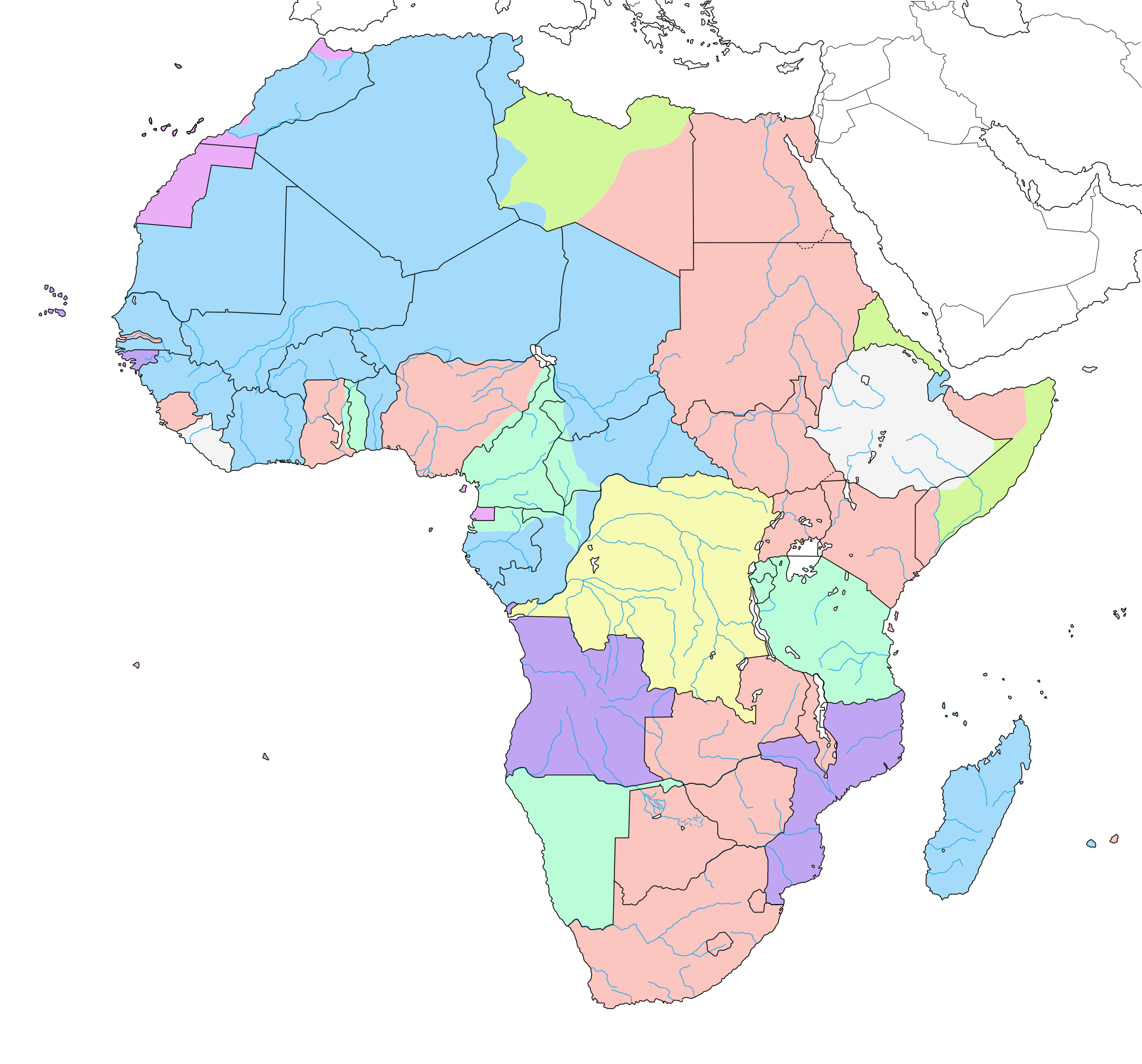
European claims in Africa in 1913
Spain - Purple
France - Blue
Britain - Red
Germany - Green
Belgium - Yellow
Italy - Lime
Free states - Gray
Congress of Berlin
13 June - 13 July 1878
After the Russo-Turkish War (1877-1878)
Russia defeated the Ottomans quickly
6 Powers at the congress
Russia, Britain, France, Austria-Hungary, Italy, Germany
Also included the Ottomans, Greece, Serbia, Romania, and Montenegro
Ended with the Treaty of Berlin
Replaced the Treaty of San Stefano (The treaty Russia imposed on the Ottomans directly after the war), which had decreed:
Created a self governing Bulgaria and set its borders, it was immediately influenced by Russia
Montenegro got more land and Ottomans had to recognize its independence
Serbia became independent and got more land than the Serbian region in the Ottoman Empire
Ottomans had to recognize Romania
Bosnia was supposed to become autonomous
Bismarck was present as the leader of the congress
Sought to stabilize the Balkans
Sought to balance the interests of Russia and Austria-Hungary
Reduce the Ottoman Empire’s power in the Balkans
Prevent Russia from gaining too much influence over the region and prevent a Greater Bulgaria
Keep Constantinople under Ottoman control
Romania got full independence
Serbia and Montenegro got full independence, but lost some territory
Bosnia fell under Austro-Hungarian control
Britain took Cyprus
Bulgaria gained partial independence
Remained under control of the Ottoman Empire
Had less than half of what they were given in the San Stefano treaty
Macedonia was returned to the Ottomans
Russia wasn’t happy with the treaty due to the lack of gains
The Russians had fought the war and didn’t make gains
Ottomans became the ‘sick man of Europe’
Pan-Slavism
Due to the treaty’s stipulations, the Slavs weren’t happy and caused riots, especially in Bosnia
Slavs and Russians hated Bismarck
The main goal of some of the participants in the Congress was to end pan-slavism, as they were worried the movement would cause revolts against Habsburg rule
Diplomatic effects
Led to rising tensions between Russia and Austria-Hungary
The borders outlined in the Treaty of Berlin were not accepted by the Balkan states, led to the first and second Balkan Wars
Bismarck later realized he had tied Germany too closely with the Austro-Hungarians
Slav nationalism in Bosnia led to the assassination of Archduke Franz Ferdinand
Balkan nationalism is considered one cause of the First World War
Russia was discontent that their power had been overshadowed and ignored
Three Emperors League destroyed
Result - The attempt to make peace in the Balkans was considered a failure as this treaty led to the Balkan Wars and World War One
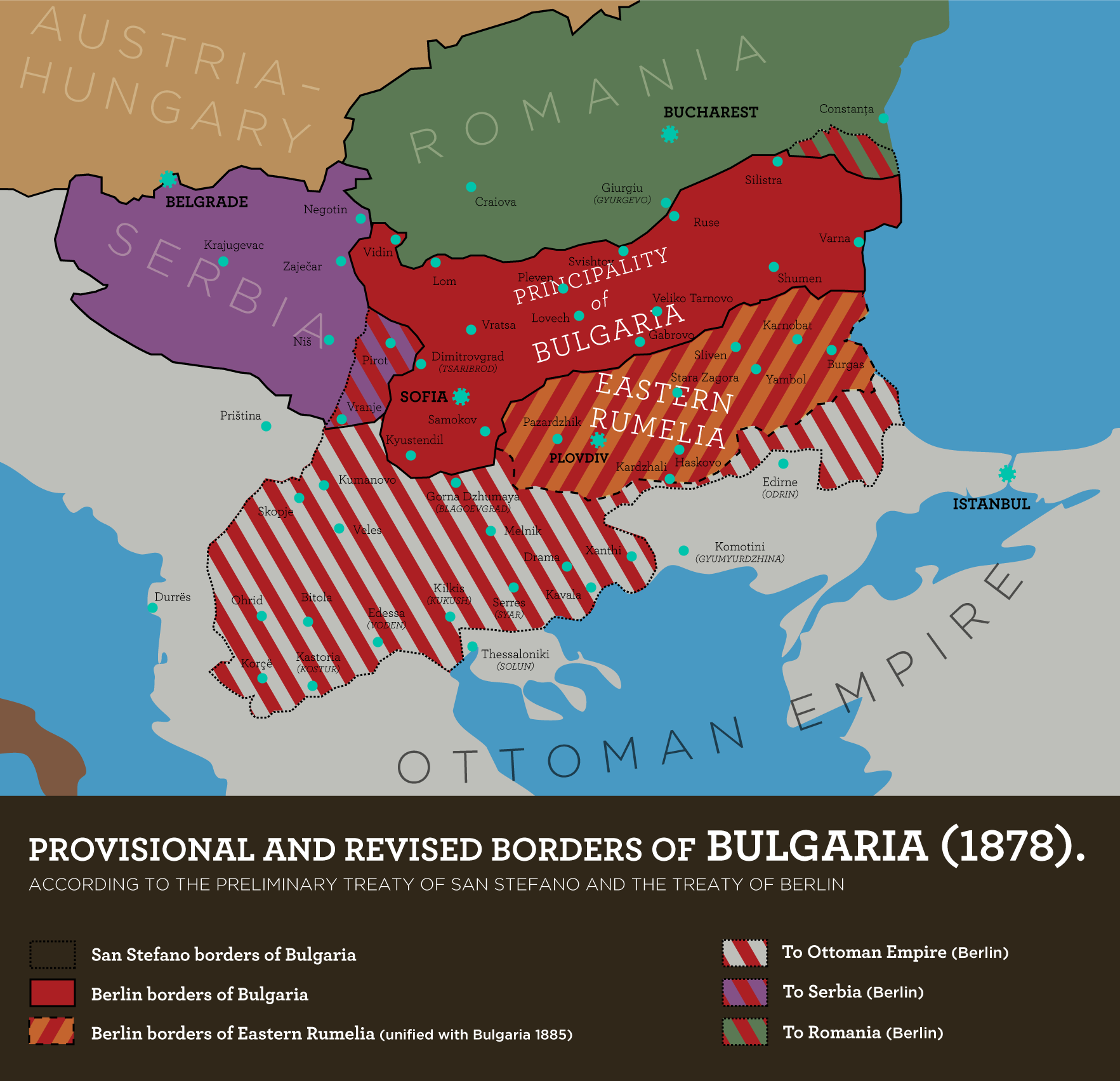
San Stefano versus Treaty of Berlin borders
By TodorBozhinov - Own work, CC BY-SA 3.0, https://commons.wikimedia.org/w/index.php?curid=9944110
Domestic Conditions & Goals
Ottoman Empire
Sultanate
Many ethnicities, the population had Islam religion forced on them
Slavs were Christian
This policy appealed to the Islamists but antagonized Christians
Failing economy by 1900, sold assets to Europeans
Anglo-Persian Oil Company was sold to Britain, which angered Turk nationalists
Britain, France, and Russia wanted Ottoman land
Valuable ports and resources
Easier travel to India
Prospect for oil
Russia wanted to free the Holy Lands and control the Balkans
Ottoman ports on the Black Sea and the Mediterranean were better than Russian ports, as they were not frozen for part of the year
‘Save’ Slavic people
Control Constantinople to let their ships travel freely
Thus, these countries were praying on the fall of the Ottoman Empire to take these lands
European powers took most of the Ottoman’s land after the empire fell
Many riots and independence movements
Russia encouraged Slavic states to fight for independence
They could influence these states to use ports and resources
Greece gained independence in 1929 after the independence war of 1921-29
Ethnic and social divisions
Regime was corrupt and aimed to serve their own personal interests
High foreign debt as economy was failing
Owed 200,000,000 pounds to European banks by the 1870s
Internal political discontent
Calls for modernization and westernization
Short lived revolution in 1876 - A group of young Ottomans who had been educated in European universities launched a revolution and overthrew the Sultan, implementing a constitutional monarchy, but these reforms did not last long. However, they were revived by the Young Turk movement in 1908.
One of the Young Turks was an army officer who played a minor role in the revolution named Mustafa Kemal Ataturk
Britain
Strong naval power
Moved naval fleets to Mediterranean after San Stefano to intimidate the Russians
They used this as an intimidation tactic to maintain dominance
Showed somewhat hostile foreign policy
Opposed Russia’s treaty stipulations
They did not have good relations
There was a war with Russia over Crimea in 1853, which soured relations between the powers
Forced Greater Bulgaria to split into 3 states to keep the Russian’s influence and power low
First nation to industrialize - Had a head start
Quick to innovation, the source of many new products and systems
Capable of mass producing products quickly
Developed train networks across the empire
Built navy and merchant ships very quickly
Innovated with the Dreadnought in 1906
Rapid industrialization caused crimes, bad living conditions, prostitution, poverty, child labor, and poor sanitation
Writers such as Charles Dickens wrote about the social and economic problems
Britain had the most powerful trade
Domestic working class discontent
Many protests
The parliament was democratically elected, but only the people with a certain amount of land could vote, which did not include most of the working class
British Labor Party formed in 1900
Was in the process of re-evaluating ‘splendid isolation’
Look for allies in Europe and Asia to balance the power of Germany
Declined in trade and economic power in the 20th century
Resources were spread thin across the empire
Germany and the USA surpassed Britain in industrial output in the 1880s
Wanted to preserve dominance over the seas and preserve the balance of power in Europe
Mainly to preserve their place as the number 1 power
Many riches gained from the colonies, making the middle and upper classes in mainland Britain very rich
Gold, silver, diamonds, cotton, and wood
This caused discontent from the working class, who was not seeing the fruits of their labor
Britain sought to protect itself against the German Empire, which influenced a lot of their foreign policy, including pushing them into an alliance with Russia
France
Politics divided between pacifist left and revanchist right
Multiple short-lived governments leading to unstable foreign policy
Good agriculture
Lots of wealth in gold and resources from colonies, mainly for the middle and upper class
Invested into colonies
Seeked an alliance with Russia
Desire to contain Germany and possibly retake Alcase-Lorraine
Economic modernization
The previous Bourbon monarchy was restored in 1814 after the end of the Napoleonic wars, this was not a popular choice
Did provide political stability and some time for recovery
Another revolution in 1848 instated a republic, government was then led by Louis-Napoleon, a nephew of Napoleon Bonaparte
Seized autocratic powers by 1852
This added to the mistrust in the government from the French people
Highlights the political issues at the time
Napoleon crowned himself Emperor Napoleon III, meaning there was another era of absolute monarchy
Defeated in the Franco-Prussian war in 1871
The French once again abolished the monarchy
Anti-German nationalism
Industrialization
Urbanization and modernization
Despite living conditions improving, the wealth disparity and poverty were still major issues
The working class did not benefit from the economic gain from industrialization
The working class discontent led to the emergence of radical ideologies
Political changes
The government was very left-wing, socialists and centrists
Guaranteed freedom of religion
Compulsory free education
Proportional tax system
Raymond Poincare became Prime Minister in 1913, he was interventionist and anti-German, sought to strengthen France and elevate their position on the political stage
His anti-German sentiment brought France closer to Britain and Russia
Russia
Russo-Turkish war in 1877-1878
Resulted in the San Stefano treaty, which was overturned by the Treaty of Berlin
Many Russians felt they had been swindled, as their hard work had gained them not much land
Government aimed to influence Bulgaria
Wanted lands for ports and to liberate the Slavs
Gained access to the Mediterranean through Bulgaria
Fairly strong power
Had reasonable industry, not as industrialized as Britain or Germany but could still support itself
Good agriculture, though the government was inefficient with distributing food
Additionally, agricultural reforms bankrupt peasants - The government took land that had been sold to them by nobles and distributed rights to peasants and required them to pay for it, but didn’t give the peasants enough land to support them and these payments
Large workforce for industry and agriculture
Abundant mineral resources
Large population - Strength in numbers (Population of ~147 million)
Rapid urbanization led to increase in industrial output
Recession in 1899 led to mass urban unemployment
Discontent with government
Many ethnicities - Poles, Ukrainians, Finns, Kazakhs - Wanted independence
“Russian administrators, who never succeeded in coming up with a legal definition of 'Pole', despite the decades of restrictions on that ethnic group, regularly spoke of individuals 'of Polish descent' or, alternatively, 'of Russian descent', making identity a function of birth.” - Theodore Weeks
The regime felt the Poles were a direct threat to stability
Many Russians believed the government, led by Tsar Nicholas II, was not handling domestic issues correctly
Discontent led to the rise of the Communist party and eventually the revolutions in 1917
Russian Revolution in 1905 - public and military discontent with the Tsars and the elites led to the establishment of a constitutional monarchy in 1906
Living conditions for the average citizen were poor
Landlords owned the land the peasants lived and worked on and repressed these peasants
Mass strikes
Bloody Sunday - 22 January 1905 - A peaceful protest was fired upon by the Palace Guards in Saint Petersburg
October railway workers strike turned into a general strike in Moscow and Saint Petersburg
Military began striking
Naval mutiny of June 1905
Problems with railways, they didn’t reach to the rural areas enough
Defeated in the Russo-Japanese war (1904-1905)
Sparked more Russian nationalism, discontent with the Tsar, and the government was determined to prove power in the European stage
No longer seen as a European power
Slav nationalism - Free the Slavic people from Austria-Hungary and Ottomans
Interest in influencing new states to gain more political power, resources, and strategic ports
Austria-Hungary
Fear that their territories would want independence, which they did
The Empire was falling apart
Built on a weak foundation
The central government was weak
The governmental process was heavily bureaucratic
Austria and Hungary had their own separate parliaments and governments
High disunity among the people
Both Austria and Hungary operated autonomously
15 different languages across the Empire
Many ethnicities
Bohemians, Moravians, Slovaks, Poles, Hungarians, Croatians, Slovenians, Italians, Bosnians, Romanians, Austrians, Ukrainians
Low devotion to the country and military
Divide between Austrian and Hungarian interests
The empire was formed on a compromise between Austria and Hungary
Emperor Franz Josef was very conservative in his ideals and policies
Austria had been overextending its resources and military since 1815 to try to be strong
Limited industrialization - outdated equipment being produced at a rate that was not sufficient
Desire for expansion - Militaristic leaders
19th century development
Second fastest growing economy in Europe behind Germany
Developments in banking, industry, and manufacturing
Industrial development in the west, agricultural development in the east
Heavy investments in railways
Military conditions
3 different armies - Army of Austria, Army of Hungary, and the Imperial Army
The first 2 were protected by the parliaments, but the 3rd was short of officers and was 75% Austrians
Austrian officers spoke German, but the soldiers were other ethnicities that didn’t understand German
Very bad communication between officers and soldiers due to the language gap
Most soldiers were conscripted, which lowered morale
High command copied Prussian methods
Most regiments were equipped with modern arms
Modern army was undermined by political and social issues
Germany
Constitutional monarchy until the end of World War One
Authoritarian power held by the Kaiser and the Chancellor
Strongest industrial power in Europe
Overtook Britain by 1900
Government implemented policies to encourage economic growth
The agricultural sector did not grow as the industrial sector had, but was still able to support the German people
Coal production increased 6 times by 1913
Very large working and middle class who had a tense view of the government
Expansionist policy, wanted an empire
Gain influence and resources
Weltpolitik - The idea that Germany deserves a colonial empire and deserves to be the strongest in the world
Wanted land from Belgium, France, and Russia
Feared the fall of the Austro-Hungarian empire, as they were Germany’s only real ally
Constant fear of encirclement - Avoid a war on two fronts - Their fears came true when France and Russia joined an alliance
Bismarck’s fear, he wanted to avoid it by preventing war and lowering tensions
Bismarck was very smart in how he dealt with foreign policy, but then Wilhelm II became Kaiser and he was not smart with foreign policy
After unification, Kaiser Wilhelm I of Germany left foreign affairs to Bismarck, but Wilhelm II was arrogant and wanted to do it himself
German unification in 1871
Attempts had been made to unify Germany before that had failed, but due to German nationalism in the late 19th century, this time it succeeded
Most powerful member of Germany was Prussia, with the strongest army and navy
Bismarck led the German Federation in the war
Kaiser Wilhelm I of Prussia became the first Kaiser of Germany
Germany Foreign Policy
Germany’s role in international relations
Military
The combination of the military powers of the German states in World War One meant a major diplomatic power, as it added together the influence that these states already had
The chancellor typically handled foreign policy, along with his foreign minister
The army wasn’t under the control of the government, it reported directly to the Kaiser
Germany maintained the Prussian style of diplomatic relations, sending young officers to report on the strengths, weaknesses, and military capabilities of the countries they were assigned to
These reports provided a significant advantage to the German army
Bismarck was annoyed by the military officers’ interference in foreign policy, as he had no control over the army
The military tried to convince the Kaiser to declare war on Russia in 1887 and encouraged Austria to attack Russia
The military leaders did refrain due to complaints from Bismarck
Chief of German General Staff Alfred von Schlieffen called for a war against France during the First Moroccan Crisis
In July 1914, Chief of Staff Helmuth von Moltke advised Austrian Chief of Staff Franz Conrad von Hotzendorf to mobilize against Russia, this was without the knowledge of the Chancellor or Kaiser
During World War One, Paul von Hindenburg and Erich Ludendorff increasingly took control over foreign policy
Bismarck
Bismarck’s main aim was to maintain peace as Germany had all it wanted so it just needed to maintain the status quo
Maintaining relations with France was difficult after the Franco-Prussian war of 1870-71
France was seeking vengeance for the German seizure of Alcase-Lorraine
Bismarck didn’t want to take any land from France, but the German public wanted to humiliate them and the army wanted it because it was more defensible
Bismarck gave in to these demands as he felt France wouldn’t forgive Germany anyway, so he’ll take the lands because it would make no difference
Bismarck later believed the annexation was a mistake
After the Franco-Prussian war, the only way forward Bismarck could see was to isolate France, thus leading to him attempting to create his system of alliances
Bismarck system of alliances
Multiple attempts to ally with Russia and Austria-Hungary at the same time fell through, possibly worsened relations between those two
Three Emperor’s League (Dreikasierbund) - 1872
Austria, Russia, and Germany
Republicanism and socialism were the common enemies and the three powers would discuss any foreign policy
Bismarck needed relations with Russia to keep France isolated
Attempted to re-create an alliance with Russia in 1905, which failed because Russia was too close to France
Dual Alliance with Austria-Hungary - 1879
1887 Reinsurance treaty between Russia and Germany pledged support for each other in the case that France attacked Germany or Austria-Hungary attacked Russia
Mediated at the Congress of Berlin
Colonialism
Bismarck was against a colonial empire until 1880, when Germany established overseas colonies
Then Bismarck helped lead the Conference of Berlin in 1885
Kaiser Wilhelm’s foreign policy
Removed Bismarck in 1890, effectively ending the Bismarck foreign policy victories
Wilhelm was erratic and reckless
Under the new German foreign office, led by Friedrich von Holstein, the government made poor choices
Believed coalitions between Russia and France would fall apart, so there was no need to worry
Believed Russia and Britain would never ally
Believed Britain would eventually seek an alliance with Germany
Germany refused to renew its treaties with Russia, allowing Russia to seek a closer alliance with France, as both were worried about German aggression
Attempted to ally with Britain, but Britain refused
Engaged in the naval arms race with Britain, pushing them further away even though the relations between the two had been improving
Germany had become increasingly reliant on the Triple Alliance as they became more and more isolated
Desire to make the Imperial German Navy stronger than the British Royal Navy
Admiral Alfred von Tirpitz led the navy, and dramatically expanded the naval fleet in the early 1900s to protect the colonies
Started a warship construction plan in 1898
Constructed a large naval base in the North Sea island of Heligoland, which they had gained in exchange for Zanzibar. This base directly threatened British naval power
The British still maintained their naval power over Germany, especially when they launched the Dreadnought in 1906
First Moroccan Crisis
Germany was unhappy that France tried to create a protectorate over Morocco, because France hadn’t consulted them about this
Kaiser Wilhelm declared support for Moroccan independence
Wilhelm made a very provocative speech on this, seemingly trying to annoy France
At Algeciras, no other European state (except Austria-Hungary) sided with the Germans, and it was considered an embarrassment
The French gave up some control over Morocco
Second Moroccan Crisis
France tried to suppress a revolt in Morocco, and Germany wanted to be involved
This was resolved when France agreed to give Germany territory in Central Africa in return for Germany not interfering in French affairs
These Moroccan crises both resulted in failure for the Germans, and this made them much more aggressive in nature
Germany became more ready for war
Fears of encirclement
Germany was very suspicious of those around them
The alliances between Britain, Russia, and France confirmed Germany’s fears of encirclement
Crucial decisions going into World War One were made by solders and that, in making them, they displayed an almost complete disregard for political considerations
Fears of encirclement became more potent in German foreign politics after the First Moroccan Crisis
Gordon A Craig - American Historian
Historiography
“In retrospect it is easy to see that the annexation of Alcase-Lorraine was a tragic mistake”
Otto von Bismarck - German Chancellor
The encirclement Germany found itself in was of its own making. This was done by alienating France, failed attempts to ally with both Russia and Austria-Hungary, and rivalling England’s navy. They alienated most of their neighbors, only to complain when these neighbors turned against them.
G M Trevelyan - English Historian