Japanese Expansionism
-
Causes of expansion: Impact of Japanese nationalism and militarism on foreign policy - Domestic issues: Political and economic issues and their impact on foreign relations - Political instability in China
Events and Responses: Japanese invasions of Manchuria and Northern China (1931) - League of Nations and the Lytton Report
Sino-Japanese War (1937-1941) - Political developments within China, the Second United Front
The Three Power-Tripartite Pact: The outbreak of war, Pearl Harbor (1941), International response including US initiatives and increasing tensions between the US and Japan
-
The successes and failures of peacemaking - Treaty of San Fransisco (1951) - Only if the question asks for peacemaking from 2 wars of in 2 regions
Jump to sections
Causes of Expansion
Nationalism
Believed they were destined to lead the Asian sphere
Become imperial power
Faced discrimination from Western Powers - Treaty of Versailles
After the First Sino-Japanese War, Germany, Russia, Britain, and France got involved
Forced Japan to give up the Liaodong peninsula - This was taken by Russia
Germany took the Shandong Province
Britain and France took various ports on the Chinese coast
This angered the Japanese
Economic
Japan had few natural resources on the mainland to support their population
Saw resources in China and Manchuria, wanted to take them
Manchuria was agriculturally and resource rich
Population was growing rapidly
Great Depression - 1929
Worsened economic conditions in Japan
USA launched protective tariffs, the Smoot-Hawley Act, increased Japanese imports costs by 200%
Crushed Japanese exports - Leads to unemployment
Great depression pushed the army and government to want to rely on their own resources, needed to conquer places like Manchuria to get these resources
Manchuria had natural resources and living space that the Japanese could use to grow the economy
Japan’s “only means of survival”
Political
China
Government is unstable after the fall of the Qing Dynasty
China was divided between multiple parties competing for power
Rivalry between two main parties divided the nation
Guomindang (GMD) led by Jiang Jieshi versus the Chinese Communist Party (CCP) led by Mao Zedong
Start of the Civil War in the 1920’s
Nationalists vs Communists
Chinese instability emboldened Japanese militarists and nationalists to expand in Asia
Weak power with large resources that can be taken easily (or so they thought)
“Northern Expedition” - Jiang Jieshi led a movement to unify China and sent his armies to the north of China to conquer these territories (Including the Manchurians)
Japan
Democratic government was fragile
Financial scandals led to declining public support
Election law violations - Reduced public support for political parties
Fears of left-wing radicalism and communism
Conservative groups and the army questioned internationalism
The post-war economy slumped, made worse by the 1929 Great Depression
Japan is deeply reliant on foreign trade, both imports and exports
Political instability
China’s Northern Expedition worried Japan, as they wanted Manchuria
A Manchurian warlord, Zhang Zuolin, had plans to invade into China
Japan’s military went to assassinate Zhang without the Emperor’s permission, first signs that the military was acting on its own
Kwangtung army based in Korea went to assassinate him
Japan didn’t want to see a strong Manchuria that was united with China, as they wanted to conquer Manchuria and China
Opposition to Internationalism
Internationalism seen as a betrayal of Japanese interests
Militarism
Desire to become a western-style military power
Copied Prussian army’s high command style, this made them a strong army
Created a new navy with Britain’s help
Desire for security
Historic Developments
1853: US fleet arrived in Tokyo Harbor - Commodore Matthew Perry
Japan knows the British caused the opium wars in China, did not want to have that happen to them
They do not want to be under the control of another western nation
Grows anti-government and anti-isolationist sentiment among the people
USA demanded Japan open up to trade, they agreed because they were scared of what could happen if they didn’t - West had impost humiliating treaties on China
1868: Meiji Restoration - Revolution to modernize Japan
Restored Emperor to power
Ended isolationism
Reform based on western models
Peoples representation
Created a constitution with the Emperor as commander-in-chief of the military
Emperor was a symbolic figurehead, now he has real power
Economic reforms pushing industrialization
Education reforms
Model Japanese schools on German schools
Government dictates what gets taught at schools
Develop nationalism
Military reforms
Turn traditional warrior ideals into westernized military officer ideals
1894-95: First Sino-Japanese War
Japan becomes an imperialist power
Proving themselves as a power in the east
Japan won
Takes land from China - Taiwan, Korea, Manchuria
1904-05: Russo-Japanese War
Japan decimated Russia’s naval fleet
They destroyed the eastern fleet, waited until the Baltic fleet arrived months later, then destroyed that too
Caused Russian nationalism and militarism, possibly being a cause of World War One
Japan proves that they’re strong, they can beat a major European power
Takes some land and expand empire
1914: First World War
Joins the Allies
Helps attack German pacific holdings
Gained German holdings in East Asia from winning the war
Japan insisted on a racial equality clause, this was denied. This angered the Japanese - This grows nationalism and militarism
They wanted equal representation
Western powers decline due to colonial holdings
1920’s: Internationalism
Led by Shidehara Kijuro (Diplomat and later, foreign minister)
More international role in global politics
Participated in the Washington Conference of 1921-22
Multi-Lateral treaties: Four-Power; Nine-Power; Five-Power Naval Treaty
Four-Power: USA, Britain, France, Japan - Agreed to diplomacy if any Asian holdings were threatened
Nine-Power: Added into the Four-Power treaty, determined to keep China open for all these powers
Five-Power Naval Treaty: USA, UK, Japan, France, Italy - Limit the size of the navy to prevent another arms race
Japan had to agree to have a smaller navy than the other powers, they do not like this discrimination
Japan had plans for huge naval expansion, this had to be abandoned
Japanese Expansionism
Mukden incident
Outside of a town called Mukden in Manchuria
Explosion at a Japanese-owned railway on 18 September 1931
Japan gained these railways as concessions from the Sino-Japanese war
Kwangtung army claimed it was an attack by the Chinese
Army began attacking Manchuria
By early 1932, Manchuria was completely under Japanese control
Army acted without permission from the Emperor
Kwangtung army goes to seize Manchuria against the Emperor’s wishes
Manchurian Crisis
Crisis
Military expansionism
Fighting broke out in Shanghai
Japanese Air Force bombed the city
China ceded control of Manchuria to Japan with the Treaty of Tanggu in May 1933
Pu Yi established as puppet ruler of Manchukuo (Japanese name for Manchuria)
Pu Yi was the last ruler of Qing China, he was a young boy at the time, and the Japanese put him in charge so public image would be that there was a local with good public relations ruling Manchukuo
Jiang hoped that would be enough for Japan and that they ultimately couldn’t hold it
“Japan was a disease of the skin, communism was a disease of the heart”
Jiang Jieshi belived the Communists were more important to deal with than the Japanese
Result
Worsened relations between Japan and western powers
Japan would be condemned by the League of Nations
Abandonment of internationalism
Japan benefitted economically
The GMD was focused on defeating the CCP in the civil war
Showed that Japan’s military was actually in charge, not the Emperor, as they acted alone
The Dark Valley
Years of political and military division within Japan
Separate imperialist political factions
Imperial Way: Pushed for military dictatorship and saw the USSR as Japan’s main enemy
Control Faction: More military influence in the government and pushed for conquest of China
Following an assassination attempt by Imperial Way on a Control Faction leader, 1500 Imperial way officers marched into Tokyo attempting to seize power in Feb 1936
Coup failed, Imperial Way was discredited
Control Faction General Hideki Tojo became Chief-of-staff of the Kwantung Army and within weeks, moved to invade China
The Second Sino-Japanese War
Beginning
Marco Polo Bridge Incident - July 7 1937
Japanese soldiers moved across the bridge, crossing the border, to conduct military exercises. They were met by Chinese forces and somehow (the cause is unknown), they exchanged fire. This began the war
War
Ground war supported by devastating air raids
Signaled what war had become, insight into what World War Two would look like
Rape of Nanjing
The GMD government moved to Nanjing from Beijing, and Nanjing became a target for the Japanese
The Japanese attacked ferociously, committed horrid atrocities and crimes against humanity on Chinese civilians
Brutal Japanese attacks
Result
Japan had hoped the Chinese would surrender quickly, this did not happen
Strong Chinese nationalism
Jiang Jieshi and Mao Zedong joined forces to defeat the Japanese
Second United Front - Started by the Second Sino-Japanese War and ended after the war when GMD and CCP continued fighting for control
Chinese Guerrilla tactics
International outrage over atrocities committed
Japanese hoped to build the ‘Greater East Asia Co-Prosperity Sphere’
Japan claimed it was to drive out western forces and influence, in reality it was Japan seeking their own influence over these states
This also hoped to make China surrender, which failed
Military exerted more control over the civilian government
In October 1941, General Tojo became the Prime Minister
Tojo led the fight in the Second Sino-Japanese war
Tripartite & Neutrality Pacts
Tripartite Axis Pact
Germany and Italy
September 1940
1 year after World War Two started
Germany and Italy would focus on European expansion and Japan would focus on East Asian expansion
Japan could seize colonial holdings in Asia
Neutrality Pact - USSR
April 1941
Right before the USSR is attacked by Germany
Eased Japanese concerns on their northern border
They could focus on southeast Asia and not have to worry about Russia
The current faction in charge of the government did not see the USSR as a threat like other factions did
Japan and USSR wouldn’t fight each other, though they were fighting each other’s allies
Russia scrapped the pact in 1945 and joined the campaign against Japan
Greater East-Asia Co-Prosperity Sphere
Now included Southeast Asia
Attacks against the USA, Britain, and the Netherlands
Each power had holdings in Southeast Asia (and Pacific)
USA had Hawaii (Wasn’t a state yet, just an occupied territory) and Philippines (Puppet state, taken from the Spanish in 1898)
UK had British Malaya (Now Malaysia), Singapore (Part of British Malaya), Hong Kong and Australia (The ‘Papua New Guinea’ part)
Netherlands had the Dutch East Indies (Now Indonesia)
Japan’s move into Indochina (Now Laos, Vietnam, and Cambodia) resulted in a US embargo on Japan
Japan desperately needed resources from the USA - Oil, Steel, and Iron
Since France fell to the Nazis, the Japanese could take Indochina because Vichy France had good relations with the Germans, who were Japanese allies
Negotiations failed to resolve the situation
Japan prepared for an attack even while the negotiations are happening
On December 7, 1941, Japan began attacks on: Pearl Harbor in Hawaii, Hong Kong, Singapore, the Dutch East Indies, and Malaya
Goal to incapacitate the US Navy
Somewhat failed due to many strategic errors and some luck - the USA’s aircraft carriers of the Pacific fleet were somewhere else and the Japanese fleet didn’t attack repair yards or fuel depots, meaning the USA could recover quickly
Though they made mistakes, 90% of American mid-Pacific air and sea power was destroyed or damaged, but they fixed it quickly
Pearl Harbor was not closed
USA declared war on Japan on December 8, 1941 (President Franklin Delano Roosevelt)
Wanted to force the USA to yield and re-open trade with Japan. This did not happen.
Just made the situation worse for Japan, as now they were at war with the Americans and brought them into the war
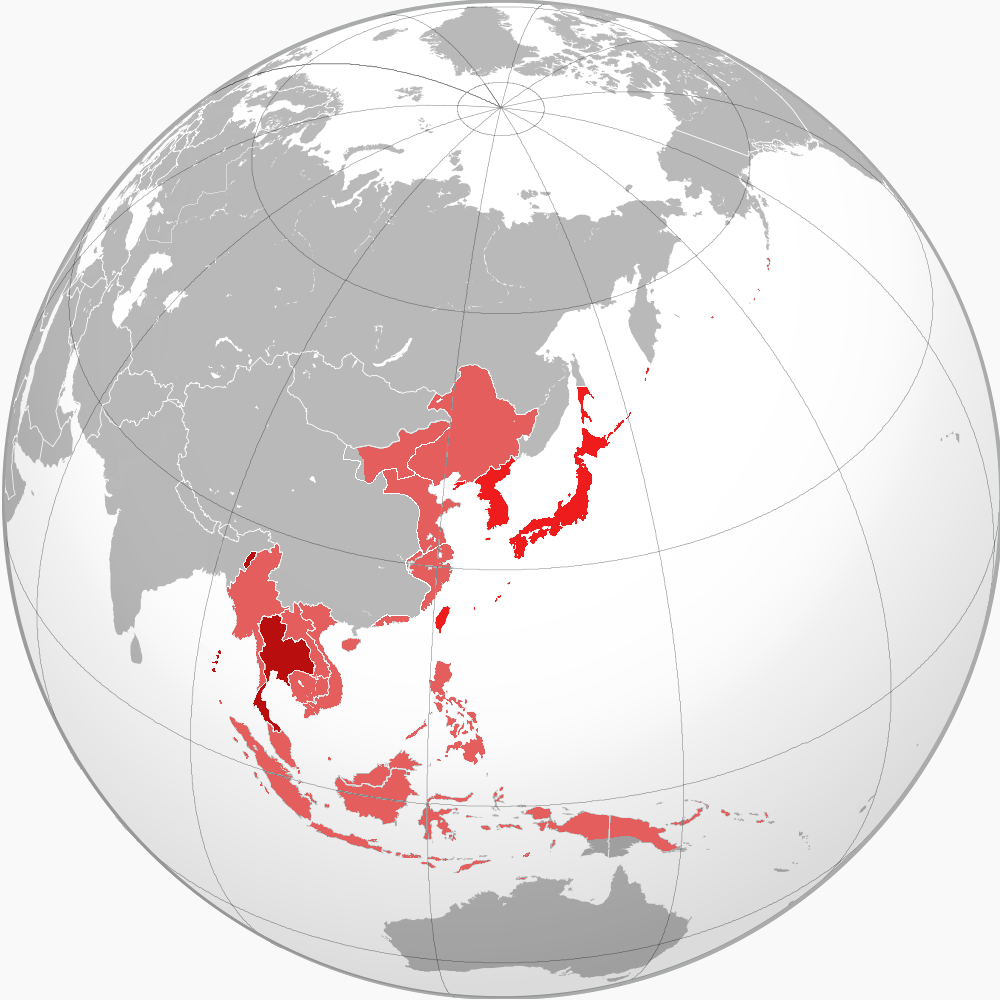
Greater East Asia Co-Prosperity Sphere at its peak:
Dark red is Japan and its allies
Light red is occupied territories
International Response to Expansionism
Manchurian Crisis
Failure of collective security
The League of Nations lacked the influence of the USA and had no enforcement without League consensus
The USA never joined due to the senate rejecting it
No power could agree due to their own self interests
Since the USA wasn’t there, Japan could be sanctioned and still be fine due to trade with the Americans
Kellogg-Briand Pact had no enforcement
The international agreement for countries to not go to war
Major failure of the League of Nations
League did not sanction Japan or intimidate them
China appealed to the League following the Mukden Incident
Meetings were held
Fact-finding mission sent to Manchuria: The Lytton Commission
Manchukuo created prior to the issuing of the commission’s report
The report took so long to make that Japan just continued doing what they were doing and took over Manchuria
Lytton Report
Declared that Japan had special interests in Manchuria, but its use of force was unacceptable and unjustified
Japan should give up the territory and withdraw its forces
Manchukuo was not recognized as an independent state separate from China
The problems between Japan, Manchuria, and China could only be solved through Sino-Japanese cooperation
Japan refused to accept the report and withdrew from the League of Nations as a protest in March 1933
Japan could just leave and ignore them because the League had no real power
Rationale of the League of Nations
No one wanted a wider war in the region, they wanted to keep it between Japan and China if they couldn’t solve it
No one was willing to deal with it on their own, so if they can’t get everyone involved then no one will be involved
Democratic states needed to respond to public sentiment
Racist sentiments - These aren’t Europeans so they don’t matter
Public doesn’t want a war in East Asia
Economic concerns were more pressing - Great Depression was happening
The USA was not compelled to support the League’s actions
China’s response
Jiang Jieshi’s focus on the Civil War with the CCP cost him support within China
Jiang, following the Xi’an incident, agreed to an alliance with the CCP, creating the Second United Front
Xi’an Incident: Jiang went to Xi’an to review a nationalist army, but that army put him under house arrest in hopes the Chinese Civil War would end and they could confront Japan
Civil War replaced with a war of national resistance
Wider war followed the Marco Polo Bridge Incident - Strengthened the Second United Front
US Response to aggression
USA had a policy of isolationism
World War One was used to discourage future involvement in foreign wars
Strengthened by the economic depression - Economic problems at home were more pressing than foreign conflicts
US interests not seen as directly threatened by the Manchurian Crisis
US trade with Japan was more important than its trade with China - Trading more with Japan than China
USA didn’t care at first
Response to Manchuria Crisis
The Stimson Doctrine
Non-Recognition of any agreement that violated China’s territory, international law, or the Kellogg-Briand Pact
Basically, the USA would not recognize a violation of their own beliefs but won’t do anything to stop Japan
Upheld a principle, but did not commit the US to action
Second Sino-Japanese War
After 1937, Japan’s continued aggression was seen as a threat to US interests by some, including FDR (The president)
FDR was restrained by the Neutrality Acts - These were meant to keep the USA out of any international conflict and is thus why they didn’t join the war until they were directly attacked
Panay Incident - December 12 1937
Japan accidentally attacked and destroyed an American gunboat which was escorting merchant vessels, but they immediately apologized and offered compensation
Growing Anti-Japanese sentiment in the USA
By 1938, FDR began to work around the Neutrality Acts and offered financial aid to China
Neutrality acts stated the USA couldn’t assist any nation at war, but they worked around that with technicalities like ‘This isn’t a declared war, it’s just a skirmish’
January 1939: Moral Embargo
Restrict the sale of some goods like planes and aviation parts that Japan needs to continue the war
Japan needed these materials to keep their efforts up because they were bombing China so much
1941: Lend-Lease Act
More money and fighter planes sent to China
USA was getting more involved in this conflict
July 1941: USA froze Japanese Assets and issued an expanded embargo that included oil
Japan didn’t have any major oil production, so they wanted the oil extracted from the Dutch East Indies
Freeze assets in American banks
Pearl Harbor
Following the attack, the US public was strongly in favor of entering the conflict against Japan
USA declared war on December 8, 1941
Peace Treaty
Treaty of San Fransisco (1951)
Treaty between the USA and Japan post-World War Two
Process
Signed in San Fransisco on September 8, 1951
Came into effect in 1952
China was not invited due to their relations with Britain and the USA
Yugoslavia and India were invited but did not attend
48 countries signed
Japan was occupied under the Supreme Commander of the Allied Powers (SCAP) led by US General Douglass MacArthur directly after the War
During this time, the emperor was left in charge but was monitored by SCAP
Soviets objected to the treaty, claiming; It did not protect against the rise of another wave of Japanese militarism, it didn’t recognize Soviet sovereignty over the Kuril and Sakhalin islands, China wasn’t invited to the conference, and they weren’t properly consulted when the treaty was being prepared
UN had been established in 1945, conceptualized in 1943
Can be considered an effect of peacemaking
Some successes - international organization and conventions on human rights and war crimes
Some failures - Unable to maintain global peace, wars in Korea, Afghanistan, Pakistan, Vietnam, etc.
Self-interest failure: The UN is ruled by 5 countries with veto power and permanent security council membership; Russia (USSR before 1991), USA, Britain, France, and China - Called the P5 (Later P5+1 when Germany was added but they cannot be a permanent member of the permanent security council) - Each country had their own self-interest and this led to many issues on global conflicts
The People’s Republic of China objected to the treaty
The Communist side in the Chinese Civil War
The Civil War was still ongoing
The USA wanted to invite the Republic of China government to the meeting and the UK wanted to invite the PRC. As a compromise, neither was invited.
Korean peninsula would be occupied by American and Soviet troops until free elections were held - Possibly led to the Korean War
Effects
Ended imperial rule of Japan
MacArthur called for economic aid to be sent to Japan to help them rebuilt
Rebuild Japanese cities that had been firebombed by the United States
The military and secret police were dissolved
Anyone who was involved in Japanese ‘militarism or aggression’ was purged from politics
Introduced new constitution
War was forever renounced
The Japanese could not maintain an air force, military, or navy, or anything else that could have the potential for war
Kenneth Pyle - The treaty was just American self-interest but did help the Japanese as now they focused on building up industry and growing the economy rather than spending on military
Japan lost its imperial possessions
Also lost all the land it had taken during the war, to be returned to the original owner
Article 14 - The Allies confiscated all assets owned by the Japanese government, businesses, and people in their overseas territories besides in China
Valued at $25.3 billion
Article 21 dealt with assets in China, all of which were given to China. These were valued at ~$18.8 billion
Japan was to pay some assets to the International Red Cross, which would distribute the money to Prisoners of War under Japanese control
4.5 billion pounds paid
This was later used to dismiss legal cases against the Japanese government for damages to prisoners of war
Willing Allied Powers were to enter into negotiations with Japan where the Japanese industry would help assist rebuilding in these Allied countries in exchange for compensation and resources to help rebuild Japan
Japan was to pay a total of ~$1 billion to countries they occupied during the war - Burma, Philippines, Indonesia, and South Vietnam
Strengths
Pacified Japan, they focused on their industry and built a strong economy and a global trade network
Peacemakers had learned from the First World War peacemaking failures
Establishment of the IMF and World Bank to establish global trade and economic stability
There was no Third World War (as of 10/1/25)
Compensated many for the damages done to them
Created democratic states in Korea and Japan
Japan would become one of the most powerful economies later on
Weaknesses
Imperialism continued, thought it was supposed to be ended
Previous Japanese possessions found themselves under European control - Some independence movements
An example of a disagreement between USSR and USA, start of a trend throughout the mid-late 20th century
Despite global peace efforts, NATO was founded in 1949 to ‘defend against Soviet imperialism’ - The Treaty of San Fransisco was part of these global peace efforts that came from post-war peacemaking
Counterpoint to economic stability, these efforts did not stop domestic economic crises in countries across the world and did not help the 2008 global financial crisis
Did not resolve issues in Taiwan and the South China Sea
Ambiguous wording about the political status of Taiwan and the islands in the South China Sea left it open to interpretation over who actually owned the islands
As South Korea did not sign the treaty, South Koreans were not entitled to any compensation for the damages Japan did to them before and during the war